It's 2 a.m. and a resident with memory loss is standing at a side door, coat on, sure she's late for work. Nobody's at fault. The question is whether anyone knows she's there. If your only answer is "the camera will have it on tape," you have a recording, not a plan.
That's the gap a lot of administrators find when they look hard at an assisted living security system. Cameras tell you what happened. Residents, families, and surveyors want to know why it didn't happen at all.
Wandering and restricted areas come first
Most care facilities have two kinds of doors that matter. Some keep residents safely inside, like exterior exits and stairwells. Others keep the wrong people out of places they shouldn't be, like the med room, supply closets, and records. Access control handles both from one system, and it does it quietly. Staff badge or use a credential and walk through. Residents move freely through the common spaces, but a door that shouldn't open for them doesn't.
The medication area deserves its own rule. With credentialed access you get a record of who went in and when, and you can pull a badge the day someone leaves instead of hoping every key came back. We cover the details for care settings on our access control for medical assisted care facilities page, and door prop systems will flag a door that's been left open when it should be latched.
Cameras that cover the common areas without watching the residents
Put cameras where the building has traffic and risk: entrances, parking, reception, hallways, the loading dock. That tells you who came in and who left. It also settles the "he said, she said" moments with visitors, vendors, and contractors.
Think twice about everywhere else. Residents live here, and a camera in a place that feels private erodes the one thing you're trying to protect. Good video surveillance design is as much about what you leave uncovered as what you cover, and it should match your own privacy policies and what a qualified advisor tells you about resident consent. Our page on security cameras for medical assisted care facilities goes deeper on placement.
Life safety is where the paperwork lives
Care facilities carry a heavier compliance load than most commercial buildings, because the people inside can't always get out on their own. Fire alarms, sprinklers, and extinguishers all need regular inspection and testing, and the reports need to be where you can find them when a surveyor or fire marshal asks. The exact requirements depend on your state, your license type, and your local authority, so confirm them with your licensing agency and your fire marshal rather than with any vendor's blog post, including ours.
What we can say is that the systems have to work together. A door that locks to protect a resident still has to release the way your code requires when the alarm sounds. That's a design question, not an afterthought, and it's why access control and fire protection for medical assisted care facilities should be planned by the same team. Nurse call systems belong in that conversation too.
Keeping it a home, not an institution
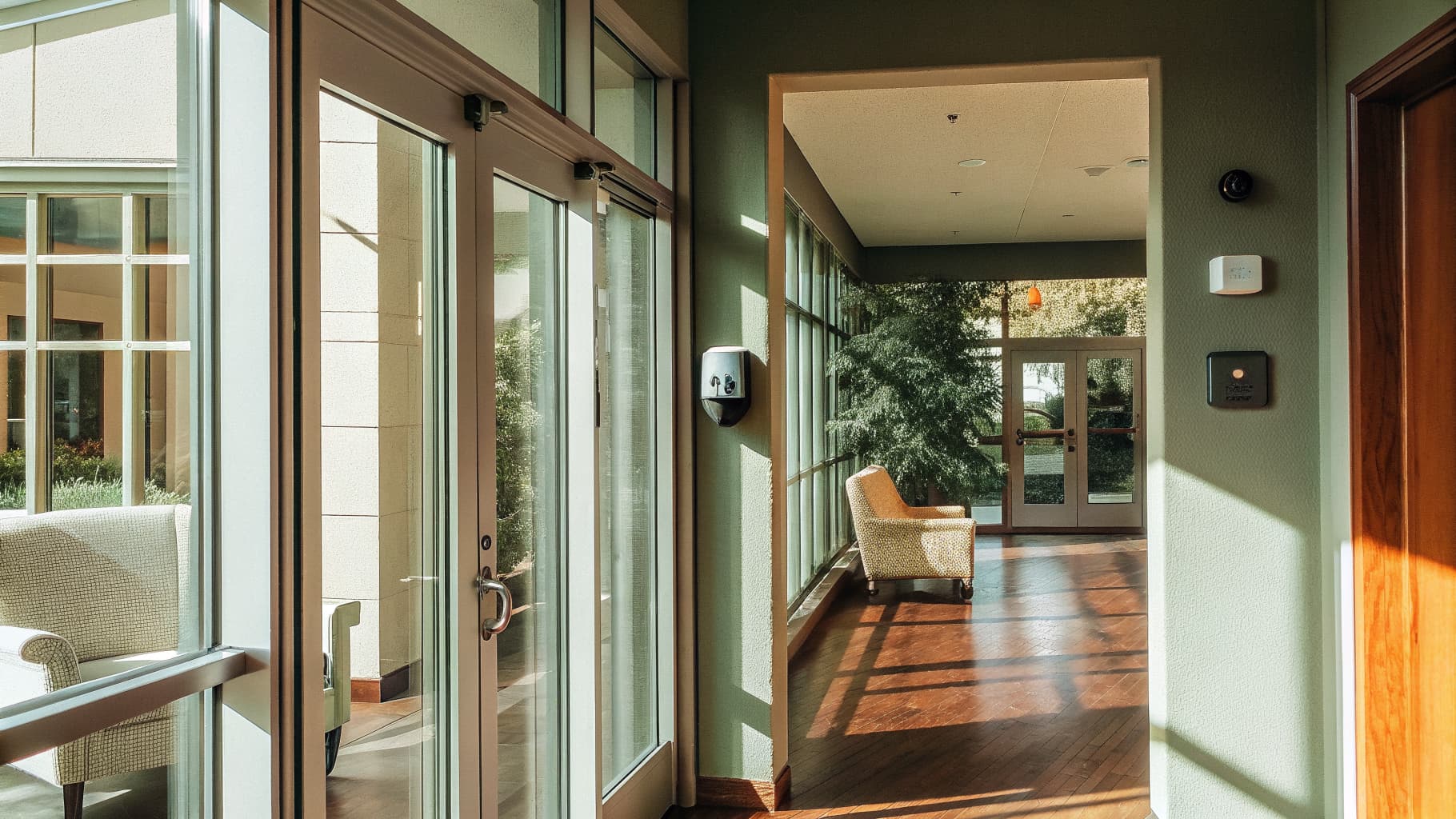
Families judge a place the moment they walk in. Bulky locks, buzzing doors, and cameras at every corner say "facility." Low-profile readers, doors that release without fuss for staff, and devices that blend into the finishes say "home that happens to be well looked after."
You don't have to pick between up to code and welcoming. Start with a walk-through: every exterior door, the med area, the hallways where residents wander, the last inspection report on your desk. That list is your plan.
Start with a walk-through
If you'd like a second set of eyes on how your doors, cameras, and life-safety systems fit together, talk to our team. We'll walk the building with you and tell you what we see.