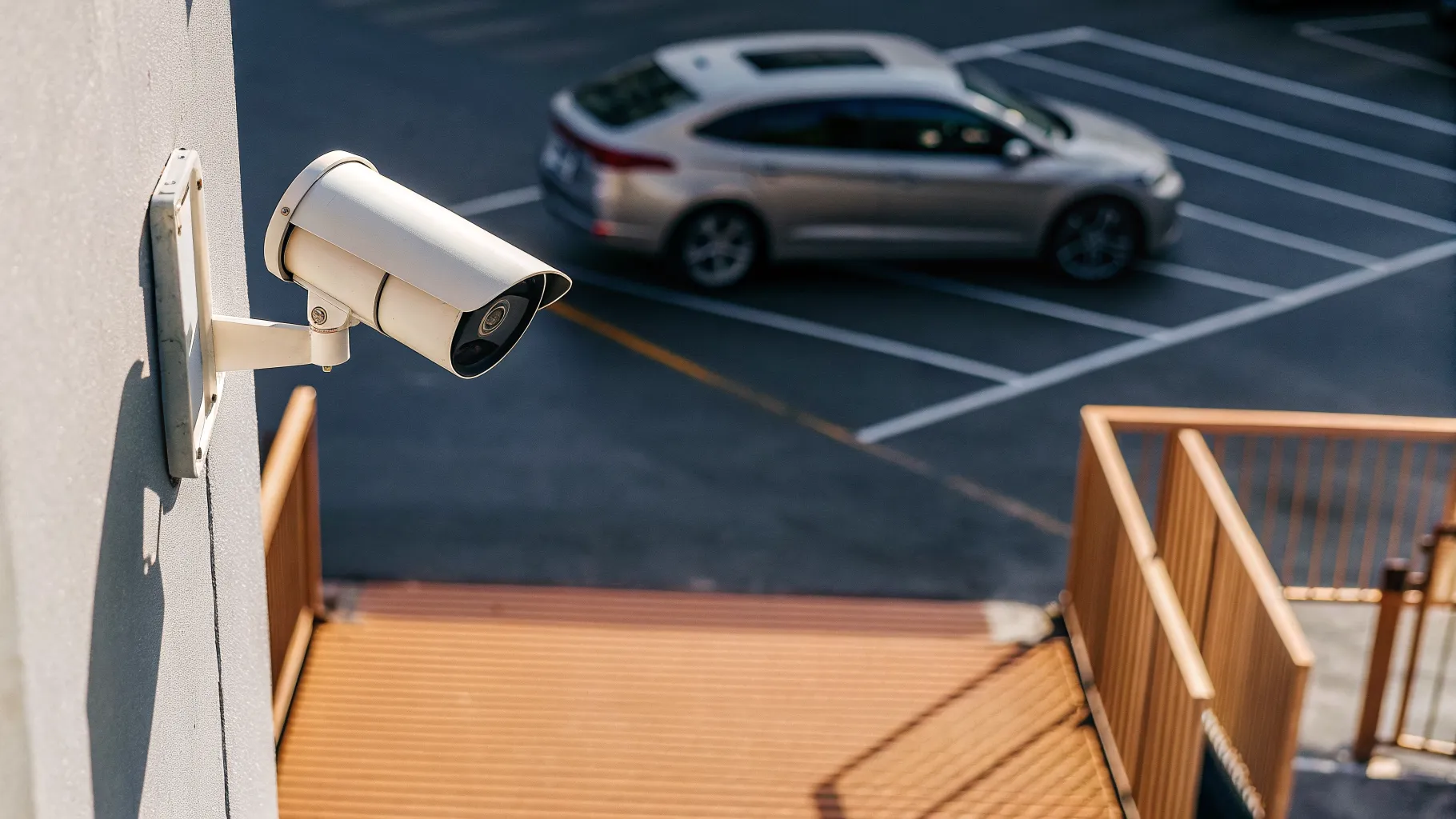
A general-purpose parking lot camera can read a plate in daylight on a car that is parked or moving slowly, if the plate is reasonably close and facing the lens. At night, or on a car moving through an entrance at 15 miles an hour, it almost never can. The footage shows headlights and a bright rectangle where the plate should be. A plate-capture camera, which is a different device aimed differently, reads plates in both conditions within limits that are worth understanding before anyone buys one.
That is the short answer. Here is the longer one, for the property manager, warehouse operator or HOA board member who has been asked whether the cameras could have caught the car.
Why the lot camera fails at night
Three reasons, and they compound. The plate is retroreflective, so when the camera's infrared illuminator hits it, the plate bounces most of the light straight back and overexposes into a white rectangle. The headlights are brighter still and pull the camera's exposure down, which makes everything but the headlights dark. And the shutter speed on a camera set up to watch a lot is slow enough that a moving plate blurs.
None of that is a defect. The camera is doing what it was set up to do, which is show a wide view of a lot with enough light to see people. Reading a plate is a different job. Why your cameras look bad at night covers the general night-image problem, which is related but not identical.
What a plate-capture camera does differently
A plate-capture camera has a narrow field of view aimed at a single lane, a fast shutter that freezes a plate moving up to highway speed, an infrared illuminator tuned so the plate reflects at a level the sensor can handle, and exposure settings that deliberately throw away everything except the plate. The image it produces is a dark frame with a crisp, readable plate in it. That is all it is for. It is paired with a second, ordinary camera on the same lane that shows the vehicle's color, make and the driver's window, because the plate camera's image shows almost nothing else.
Placement decides whether it works. The camera sits at a lane where vehicles are funneled, an entrance, an exit, a gate, a dock approach, at a shallow angle to the plate, usually within 15 to 25 degrees horizontally and a modest downward tilt. A plate camera pointed across an open lot at cars moving in any direction captures very little. Vehicle monitoring and plate capture covers the hardware, and the dual-lens LPR cameras post explains the two-camera-in-one housings that have become common.
Reading versus recognizing
Capturing a readable plate image and recognizing the characters in software are two steps. Capture is the camera's job. Recognition is software on the recorder or in the cloud that turns the image into text, logs it with a timestamp, and can match it against a list. Recognition makes the footage searchable: show me every plate that entered between 2 and 4 a.m. It also enables gate automation, where a known plate opens the gate. Recognition accuracy on a well-placed camera is high but not perfect; dirty plates, covers, trailer hitches and out-of-state formats all cost a few percentage points. For evidence, the image is what matters; for operations, the recognized text is.
What the footage can and cannot be used for
A plate image with a timestamp is useful to police investigating a theft or a hit-and-run, to an insurer, and to a property manager answering a resident's complaint. It identifies a vehicle, not a driver, and it does not by itself tell anyone who owns the car; that lookup belongs to law enforcement. Properties that record plates should say so in their camera policy, keep retention reasonable, and limit who can search the log. What you are allowed to record in an apartment building covers the legal boundaries for multifamily, and most of it transfers to commercial lots.
What it costs
Plate capture at a single lane, with the plate camera and the paired context camera installed on an existing recorder, runs $3,500 to $6,500. A two-lane entrance roughly doubles that. Recognition software is included on many current recorders and is a license on others. Replacing a general lot camera at a gate with a plate camera, keeping the cable and the recorder, is the common upgrade and sits at the bottom of the range. For comparison, a general commercial camera runs $900 to $1,800 installed; security camera installation cost has the full breakdown.
Who needs one
Apartment communities and HOAs with a gate, where the plate log answers the question of who came in after the last resident; how license plate cameras help apartments, HOAs and parking lots covers that use. Warehouses and 3PLs, where an insurer or a customer audit asks for a record of every truck in the yard; 3PL warehouse security covers the audit side. Parking decks, where the entrance lane is the one place every vehicle passes; commercial video surveillance for parking garages covers deck design. Retail and restaurant lots with repeated incidents, where the plate is the only identifying detail an overnight camera will catch.
Who does not need one: a small office lot with no gate and no incident history, where a well-placed general camera at the entrance will show the car and is a fraction of the cost.
The common mistake
Buying a plate camera and mounting it where the lot camera was, high on a building corner looking across the lot. It will read almost nothing. The camera has to be at the lane, low enough and close enough to see the plate squarely, and that often means a pole or a pedestal at the entrance rather than the building wall. We have moved more than a few plate cameras from the corner of a building to a pole at the gate, and the owner's reaction is always the same: it works now.
Adding plate capture to what you have
Most properties do not need a new system. The recorder and the cable usually stay; the gate camera is replaced with a plate camera and a context camera, and recognition is turned on if the recorder supports it. That is a one-visit job in most cases. Security camera repair is the page for a gate camera that has stopped working, and security camera installation covers the design of the rest of the lot. Properties in Charlotte, Raleigh, Greensboro, Columbia and Atlanta can send us a photo of the entrance and we will tell you where the camera needs to sit and what it will cost.