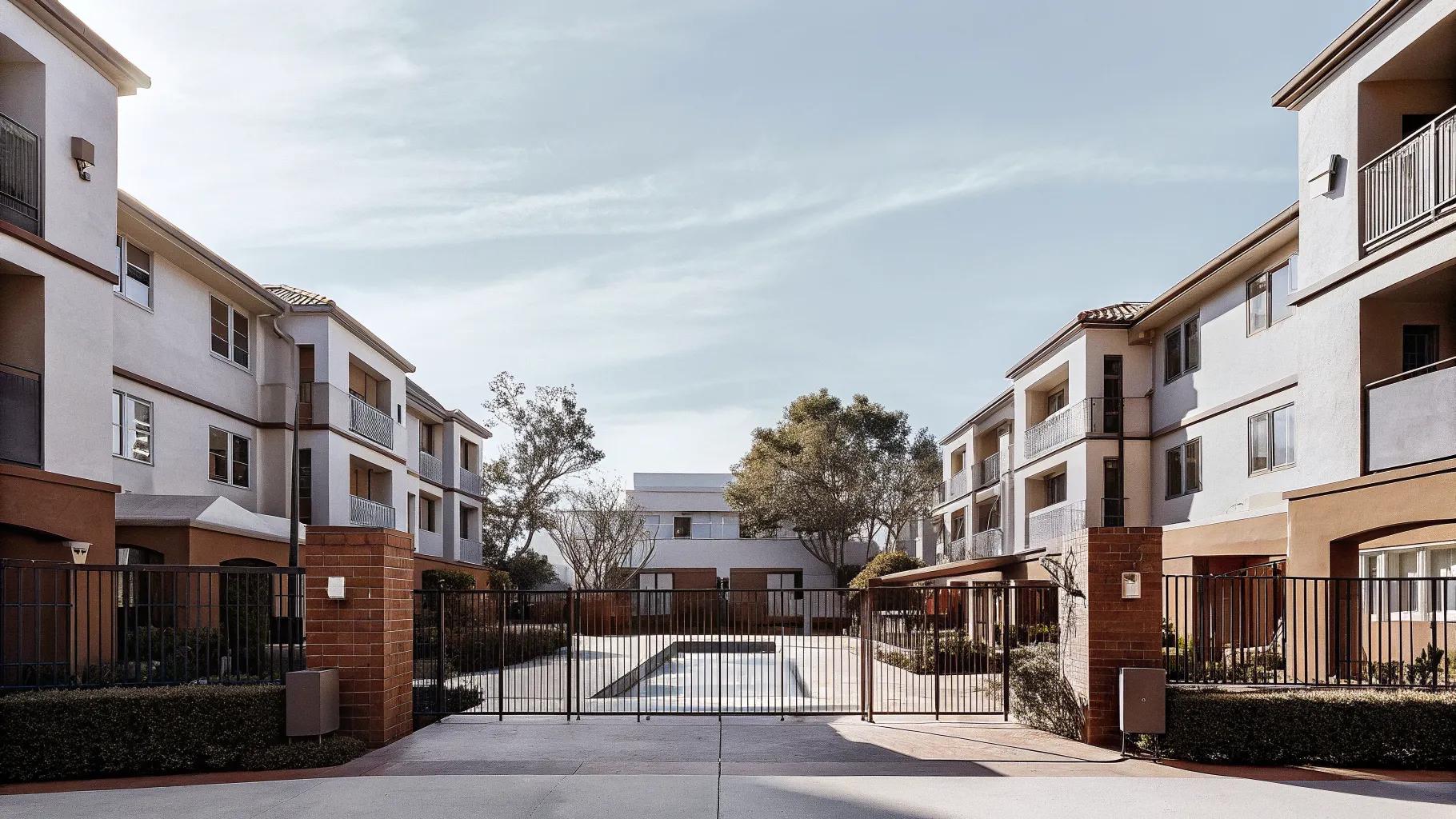
Apartment budgets get set in the fourth quarter and spent in the first, and access control is the line item that gets cut when the number arrives without a plan behind it. This is the plan. It is written for the property manager or regional who has to put a figure in the capital budget for a 50 to 300 unit community and defend it in January, and it covers which openings to control, what each one costs installed in the Carolinas and Georgia, where the recurring fees hide, and how to phase the work so the money is spent in the right order.
Start with the openings, not the units
The unit count sets the budget conversation, but the door count sets the cost. A 200-unit garden community might have twelve controlled openings: a vehicle gate, a pedestrian gate, a leasing office, a clubhouse, a fitness room, a pool gate, a mail and package room, two dog-park gates, a maintenance shop and two breezeway doors on the buildings closest to the street. A 200-unit mid-rise might have the same twelve plus a lobby, two elevators, a garage door and, if the owner wants it, 200 unit-entry readers. Those are different projects with the same unit count.
Walk the property and list every opening you would want to control, in priority order. The list is the budget. Access control for multi-tenant housing covers the full set of openings an apartment community typically controls.
What each opening costs installed
A standard controlled door, with a reader, an electrified strike or maglock, a door contact and a request-to-exit, runs $1,500 to $3,500 installed. Amenity doors sit in that range. Gates cost more because of the operator interface and the outdoor hardware: a pedestrian gate with a reader and a maglock, $2,500 to $5,000; a vehicle gate call box with a camera and plate capture, $8,000 to $10,000 typical, $6,000 to $15,000 depending on the lane layout and whether the operator stays. A lobby video intercom with a directory and per-unit answering, $3,500 to $8,000. Unit-entry readers on a mid-rise are a separate conversation and are usually priced per door in the $600 to $1,200 range for a wireless lock on an existing door, more for a wired reader.
So a garden community's twelve openings land between $25,000 and $55,000 depending on the gate. A mid-rise with a lobby intercom and elevators, $40,000 to $90,000 before unit doors. What access control costs per door breaks down each line, and gate access control covers the vehicle entrance specifically.
Where the recurring fees hide
This is the part that surprises owners in year two. Three fee structures exist, and the quote should say which one it is.
On-site systems carry no software fee. The property runs the directory and credentials itself from a browser, or puts it on a service agreement.
Cloud systems priced per door or per panel carry a monthly fee that scales with the number of controlled openings. Twelve openings, twelve fees. Predictable and modest.
Cloud systems priced per unit carry a monthly fee that scales with the rent roll. On a 200-unit community that fee runs for the life of the building and is unrelated to how many doors are controlled. Some lobby intercom platforms bill this way. It is not wrong, but it should be in the budget as a recurring line, not discovered on the first invoice. Cloud vs. on-premises access control lays out the trade-offs, and the ButterflyMX alternative page compares the per-unit model to the per-door one directly.
A service agreement at $15 to $25 per controlled door per month covers two inspections a year, batteries, priority repair and resident changes, and for most communities it is the recurring line that makes sense regardless of which platform is chosen.
Phasing a 50, 150 and 300 unit community
Fifty units, usually one or two buildings. Control the entrance, the amenity doors and the mail room in one phase; that is four to six openings and $8,000 to $18,000. A gate, if there is one, is its own phase.
One hundred fifty units, garden style. Phase one is the gate, the leasing office, the clubhouse and the pool: the openings that fail most and get the most complaints. Phase two is the fitness room, the package room and the dog park. Phase three is breezeway doors on the buildings that need them. Each phase is a quarter of the total, and the system is designed in phase one so later phases plug in.
Three hundred units, mid-rise or mixed. Phase one is the lobby intercom, the garage and the elevators, because the building does not work without them. Phase two is amenities. Phase three, if the owner wants it, is unit-entry readers, which is the largest single number and the most defensible to push into the following year. Choosing an access control system for an apartment building covers the platform decision that has to be made in phase one.
Amenity schedules and the complaints they prevent
The gym closes at 10, the pool closes at dusk, the clubhouse opens for the game on Thanksgiving. All of that is software, and all of it is free with the system. The complaints come from the edges: the resident inside the gym at 10:05, the pool gate that locks at a fixed time while dusk moves, the holiday nobody loaded. Apartment amenity hours in access control walks through each and how it is set up to avoid the call.
The system you already have
Most communities budgeting for access control already have some. A gate operator with a keypad from the developer. An intercom that calls landlines nobody has. A clubhouse reader on a platform the installer abandoned. Almost all of it has reusable wiring and hardware, and a takeover that keeps the cable, strikes and most readers and replaces the controllers and software runs about a third of a new install. The first question on any apartment budget is therefore what stays, and the answer comes from a survey rather than a guess. Apartment access control takeover covers ownership, what the old vendor has to hand back and the cutover, and telephone entry covers the common case of an old lobby panel that needs only its head end replaced.
What belongs in the budget memo
The door list in priority order. The installed cost per phase. The recurring fee structure, named. The service agreement. A line for the survey of existing equipment, which is usually free and decides the first three numbers. And one sentence on platform: open-protocol readers, a controller platform more than one integrator in the market can service, and admin credentials held in the property's name. That sentence is what keeps the next regional from writing a takeover memo in three years.
Communities in Charlotte, Raleigh, Greensboro, Columbia and Atlanta planning first-quarter work can send us the door list now; surveys done in November and December are what make January installs possible. The multi-tenant housing page covers cameras, fire and intercoms alongside access control for the full property budget.