

TL;DR:
- Advanced access control dynamically manages resource access by evaluating real-time identity, context, and policies. It operates through identification, policy evaluation, enforcement, and continuous monitoring to provide precise, adaptable security. Unlike static models like RBAC, advanced systems enhance compliance, operational agility, and security by supporting layered, context-aware permissions.
Advanced access control is a security system that dynamically manages who can access resources by combining real-time identity verification, policy evaluation, enforcement, and continuous monitoring. Unlike traditional lock-and-key or static permission systems, advanced access control systems evaluate context at the moment of every access request, factoring in time, location, device status, and user role before granting or denying entry. For property managers, business owners, and security professionals, this distinction matters because static systems fail the moment circumstances change. The shift to dynamic, policy-driven access management is the defining security upgrade of 2026.
What is advanced access control and how does it work?
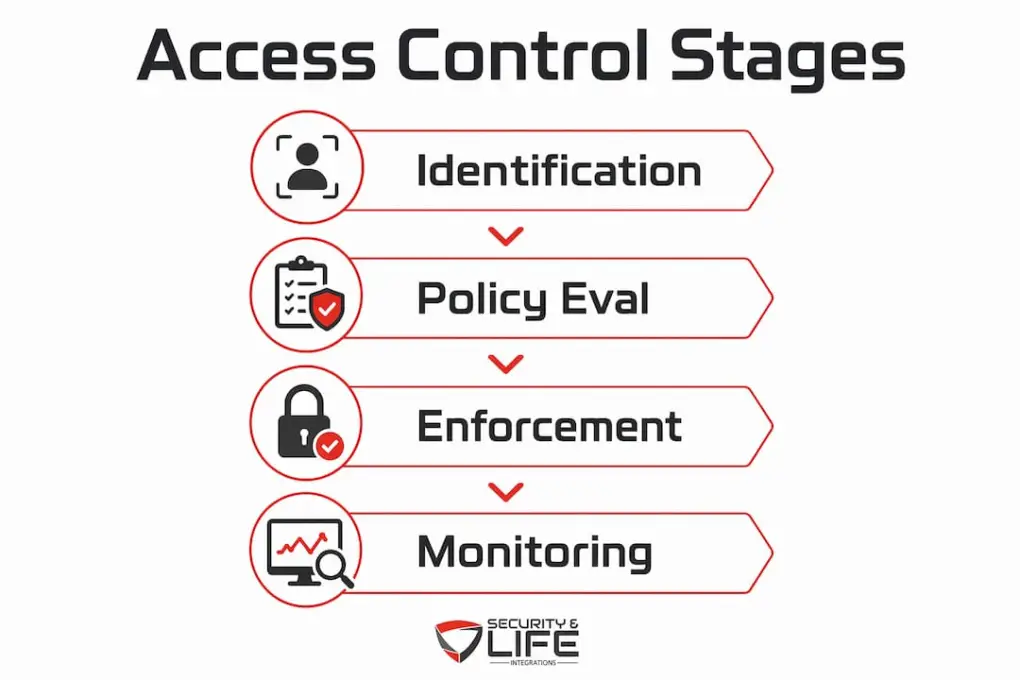
Advanced access control operates through four sequential stages: identification and authentication, policy evaluation, enforcement, and continuous monitoring. Each stage feeds into the next, creating a closed loop that treats every access request as a real-time risk assessment rather than a one-time permission check.
Stage 1: Identification and authentication confirms who is requesting access. This goes beyond a PIN or key card. Advanced user authentication combines biometrics, multi-factor authentication, and device certificates to establish a verified identity before any policy evaluation begins. Systems like IBM Verify Identity and Oracle Advanced Controls use this verified identity as the input for the next stage.
Stage 2: Policy evaluation is where advanced access control separates itself from older models. The system checks the request against a policy engine that considers attributes such as the user’s role, the sensitivity of the resource, the time of day, the user’s physical location, and the security posture of the device being used. Context-aware evaluation replaces static permission lists with dynamic decisions that reflect real conditions.
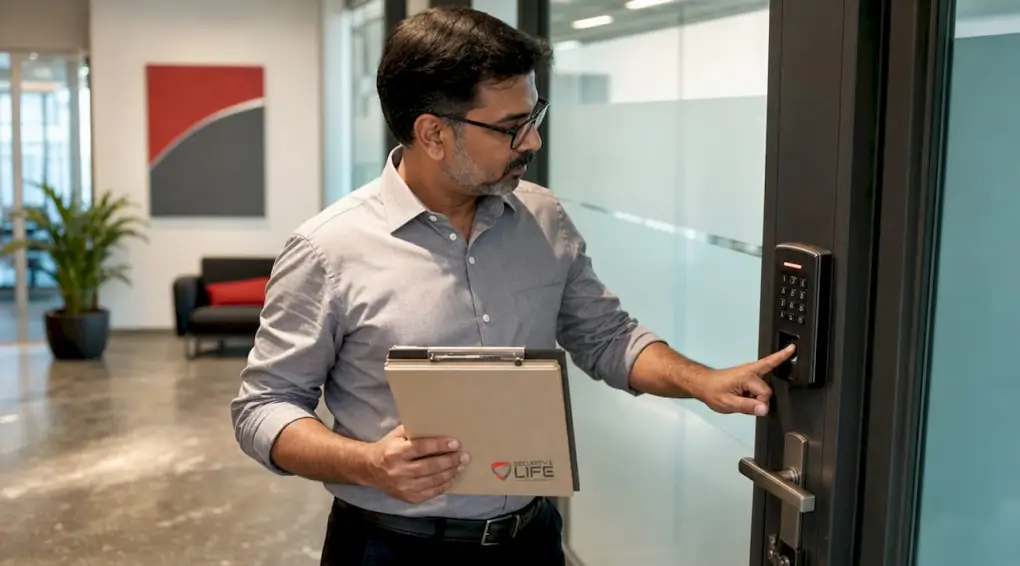
Stage 3: Enforcement applies the policy decision at the point of access. In physical security, this means a door controller receives an “allow” or “deny” signal. In digital environments, it means an API gateway blocks or permits a request. Separating the policy engine from the enforcement point is a deliberate architectural choice. Decoupled policy engines allow systems to maintain sub-50ms authorization latency, which keeps security decisions fast enough to be invisible to legitimate users.
Stage 4: Continuous monitoring records every access event and feeds that data back into the risk model. Audit logs and real-time telemetry are mandatory for compliance with regulations like HIPAA and SOC 2, and they also provide the visibility needed to detect anomalies before they become incidents.
Pro Tip: When evaluating access control platforms, ask vendors specifically about their policy engine architecture. A system that evaluates policy at the enforcement point rather than in a separate engine will struggle to scale without latency problems.
How do access control types compare to advanced models?
Understanding what advanced access control offers requires a clear view of where older models fall short. The four primary types of access control each represent a different philosophy about how permissions should be assigned and evaluated.
| Model | How permissions are assigned | Flexibility | Best use case |
|---|---|---|---|
| DAC (Discretionary) | Resource owner decides | High but inconsistent | Small teams, low-risk environments |
| MAC (Mandatory) | System-level labels, no user override | Low | Government, classified data |
| RBAC (Role-Based) | Assigned by job role | Moderate | Mid-size organizations with stable roles |
| ABAC/PBAC (Attribute/Policy-Based) | Dynamic, context-driven policy | High | Multi-tenant properties, cloud environments |
Discretionary Access Control (DAC) gives resource owners the authority to grant access. The problem is that individual owners make inconsistent decisions, and permissions accumulate over time without review. Mandatory Access Control (MAC) solves consistency by removing human discretion entirely, but it is too rigid for most commercial property environments where access needs change frequently.
Role-Based Access Control (RBAC) is the most widely deployed model in commercial settings. It assigns permissions based on job function, which works well when roles are stable. The limitation is that RBAC is fastest but least flexible. A property manager who temporarily needs access to a restricted server room still carries the same permissions on a weekend at 2 a.m. as during a scheduled maintenance window on a Tuesday afternoon. RBAC cannot distinguish between those two scenarios.
Attribute-Based Access Control (ABAC) and Policy-Based Access Control (PBAC) resolve this by evaluating multiple attributes simultaneously. Access is granted only when all conditions in the policy are satisfied. This is the foundation of advanced access control: dynamic, context-aware evaluation that replaces static roles with precise, real-time decisions.
Pro Tip: Most organizations do not need to choose one model exclusively. A layered approach using RBAC for baseline permissions and ABAC for sensitive or time-restricted resources gives you speed where it matters and precision where it counts.
What are the benefits and challenges of advanced access control?
The practical advantages of deploying advanced access control systems are measurable and directly relevant to property and business operations.
Core benefits include:
- Least-privilege enforcement. Users receive only the access they need for a specific task at a specific time. This limits the damage from compromised credentials because a stolen key card or password does not automatically grant broad access.
- Compliance support. Audit logs and access reviews generated by advanced systems satisfy documentation requirements for HIPAA, PCI-DSS, and local fire and safety codes. Property managers facing annual compliance audits benefit directly from automated reporting.
- Operational agility. Access policies update centrally. When a tenant moves out or an employee is terminated, one policy change revokes access across every door, gate, and digital resource simultaneously. There is no manual key collection or card deactivation process.
- Real-time incident response. Continuous monitoring flags unusual access patterns. A credential used at two locations within five minutes triggers an alert before a second unauthorized entry occurs.
The challenges are real and worth addressing before deployment.
Policy bloat causes performance bottlenecks when organizations add rules without a coherent governance structure. More rules do not produce more security. They produce slower decisions and more administrative overhead. The solution is a policy governance process that reviews and retires rules on a defined schedule.
Clean data mapping is the second major requirement. Advanced access control policy engines depend on accurate user attributes and resource metadata. If your directory contains outdated job titles, incorrect department assignments, or missing location data, the policy engine will make wrong decisions. Data quality is not an IT problem. It is a security problem.
Simulating policies before deployment prevents unintended access denials that disrupt operations. Oracle Advanced Controls includes sandbox testing for exactly this reason. Testing a new policy against historical access data before activating it catches conflicts that would otherwise lock out legitimate users.
Pro Tip: Run a quarterly access review as a standing agenda item, not a one-time project. Permissions that made sense during onboarding rarely reflect what a user actually needs six months into a role.
Practical applications in property security and management
Advanced access control delivers specific, tangible results in property environments. The use cases below reflect the types of deployments Security & Life Integrations supports across multifamily housing, commercial buildings, and institutional properties.
- Multi-tenant residential buildings. Access control for multi-tenant housing uses policy-based rules to grant residents access to their floor and unit while restricting access to mechanical rooms, rooftops, and other common areas. Lease expiration can trigger automatic access revocation without any manual step from the property manager.
- Integration with video surveillance. Access control readers with integrated cameras combine credential verification with visual confirmation at every entry point. When an access event occurs, the system logs both the credential data and a timestamped image, creating an audit record that is far more reliable than a swipe log alone.
- Cloud-based management and mobile control. Cloud software and mobile app platforms allow property managers to grant temporary access, review entry logs, and respond to alerts from any location. A contractor arriving on a Saturday no longer requires a manager to be on site.
- Medical and assisted care facilities. Access control for medical facilities must balance resident safety with emergency responder access. Advanced systems handle this through time-based and role-based policies that adapt to shift schedules and emergency overrides without compromising baseline security.
- Commercial office environments. Businesses managing multiple tenant suites use attribute-based policies to grant each tenant’s employees access to their specific floors and shared amenities while blocking access to other tenants’ spaces. This replaces physical key management with a centrally administered policy.
The common thread across all these applications is that advanced access control balances security and agility by enforcing least privilege without blocking the legitimate access that keeps a property functioning.
Key takeaways
Advanced access control systems outperform static models because they evaluate identity, context, and policy simultaneously at the moment of every access request.
| Point | Details |
|---|---|
| Dynamic evaluation over static rules | Advanced systems assess time, location, and device status at every access request, not just at setup. |
| Four-stage process | Identification, policy evaluation, enforcement, and continuous monitoring form the complete access control loop. |
| Model selection matters | RBAC suits stable roles; ABAC and PBAC handle complex, context-sensitive property environments more precisely. |
| Data quality is non-negotiable | Accurate user attributes and resource metadata are required for policy engines to make correct decisions. |
| Compliance is built in | Automated audit logs and access reviews satisfy HIPAA, PCI-DSS, and local safety code documentation requirements. |
Why I think most properties are still running on the wrong model
After working with property managers and security teams across multifamily housing, commercial offices, and institutional facilities, the pattern I see most often is this: organizations invest in hardware and then underinvest in policy. They install card readers and cloud platforms, then configure access by copying whatever the previous system did. The result is RBAC with the same permission bloat that made the old system a liability.
The shift that actually changes security outcomes is moving from “who has this role” to “should this person access this resource right now, given everything we know.” That is not a technology question. It is a policy question. The technology to support it exists and is accessible at price points that work for mid-size property portfolios. What is missing is the governance discipline to define policies precisely, test them before deployment, and review them on a schedule.
I have also seen organizations treat continuous monitoring as a compliance checkbox rather than an operational tool. The value of real-time telemetry is not the report you produce for an auditor. It is the alert that fires at 11 p.m. when a credential is used at a location where that user has never been. That alert is the system working as designed. Ignoring it because “we have logs” defeats the purpose entirely.
The organizations that get the most from advanced access control are the ones that treat it as a living system, not a one-time installation. Policy review, data hygiene, and incident response protocols are not optional add-ons. They are the system.
— Zachary
Advanced access control solutions from Security & Life Integrations
Security & Life Integrations designs and installs access control systems built for the specific demands of property managers and business owners.
Whether you manage a multifamily residential building, a commercial office complex, or an institutional facility, Security & Life Integrations configures systems that match your access policies to your operational reality. Their access control services include video and telephone entry, cloud-based management, mobile app control, and integration with high-definition video surveillance. Every installation is backed by 24/7 support and ongoing system management. If your current system relies on static permissions and manual key management, Security & Life Integrations can assess your property and design a policy-driven replacement that reduces risk and administrative overhead at the same time.
FAQ
What is advanced access control in simple terms?
Advanced access control is a security system that decides who can enter a space or access a resource by checking identity, location, time, and device status in real time, rather than relying on a fixed permission list.
How does advanced access control differ from standard RBAC?
Standard RBAC grants access based on job role alone, with no adjustment for context. Advanced access control adds attributes like time of day, location, and device health to every decision, making it far more precise.
What are the main types of access control used in property security?
The four main types are Discretionary Access Control (DAC), Mandatory Access Control (MAC), Role-Based Access Control (RBAC), and Attribute-Based Access Control (ABAC). Property security environments most commonly use RBAC as a baseline and ABAC for sensitive or time-restricted areas.
Why is continuous monitoring important in access control systems?
Continuous monitoring creates a real-time audit trail and flags anomalies as they occur. Without it, a compromised credential can be used repeatedly before anyone notices the pattern.
What is the biggest implementation challenge for advanced access control?
Policy bloat and poor data quality are the two most common failure points. Adding too many rules slows the system down, and inaccurate user attribute data causes the policy engine to make incorrect access decisions.