
TL;DR:
- US fire safety regulations are layered, involving NFPA, ICC, OSHA, and local authorities.
- Compliance depends on occupancy type, fire system integration, and continuous monitoring.
- Staying compliant requires ongoing inspections, staff training, community relationships, and understanding code updates.
Managing a commercial or multifamily property in the US means navigating fire codes from multiple sources at the same time. The challenge is not just understanding the rules but knowing which version applies to your building, your city, and your occupancy type. Sprinklers reduce property loss 66% and cut deaths by 80% in nonresidential buildings, yet many property managers operate without a clear picture of what they are actually required to install, test, or document. This guide breaks down the key regulatory sources, core technical requirements, inspection schedules, and the latest 2026 code changes so you can move from confusion to confident compliance.
Table of Contents
- Who writes and enforces fire safety regulations?
- Core requirements: Occupancy, egress, sprinklers, alarms
- Routine inspections, testing, and staff training
- Special cases and 2026 code updates
- What most fire code articles miss: Coordinating for continual compliance
- Fire protection made simple with Security & Life Integrations
- Frequently asked questions
Key Takeaways
| Point | Details |
|---|---|
| Fire codes vary locally | NFPA standards guide most US fire safety rules but must be checked locally for amendments. |
| Occupancy sets requirements | Building type and use determine mandatory features like sprinklers, exits, and alarms. |
| Regular checks required | Sprinklers, alarms, and extinguishers require monthly or annual inspections by law. |
| New 2026 rules | High-rises and battery storage face stricter requirements starting with the 2026 code cycle. |
| Continuous compliance matters | Ongoing staff training and coordination prevent violations and maximize safety. |
Who writes and enforces fire safety regulations?
Understanding who makes the rules is the first step toward following them correctly. Fire safety in the US does not come from a single federal law. Instead, it comes from a layered system of national standards, model codes, and local enforcement.
Three organizations drive most of the framework:
- NFPA (National Fire Protection Association): Publishes standards like NFPA 101 (Life Safety Code) and NFPA 72 (Fire Alarm Code). These are not laws by themselves, but most states adopt them.
- ICC (International Code Council): Publishes the International Building Code (IBC) and International Fire Code (IFC), which many jurisdictions adopt as their local building law.
- OSHA (Occupational Safety and Health Administration): Focuses on workplace safety, covering fire extinguishers, exit routes, and employee training in commercial environments.
US fire safety regulations for commercial buildings are primarily governed by NFPA standards adopted into the IBC and IFC, enforced by local Authorities Having Jurisdiction (AHJ).
The AHJ is the most important player for your day-to-day compliance. It may be the local fire marshal, building department, or a state agency. The AHJ has legal authority to interpret, amend, and enforce the adopted code in your specific jurisdiction. That means a rule in the model NFPA standard may be stricter, looser, or supplemented differently in your city.
| Body | Role | Scope |
|---|---|---|
| NFPA | Publishes safety standards | Fire alarms, sprinklers, egress |
| ICC | Publishes model building/fire codes | Building design, occupancy, fire safety |
| OSHA | Federal workplace safety enforcement | Extinguishers, exits, training |
| AHJ | Local enforcement authority | All adopted codes, final say |
Key point: Even if you follow NFPA 101 to the letter, your local AHJ may require additional measures. Always verify with your jurisdiction before assuming national standards are enough.
The cost-saving impact of compliance is significant. Avoiding fines, reducing insurance premiums, and preventing property damage all depend on knowing which version of a code applies to your building and who has authority to enforce it. As the property manager, coordinating this falls on you.
Core requirements: Occupancy, egress, sprinklers, alarms
Every fire code requirement in your building traces back to one starting point: occupancy classification. Get that wrong and everything downstream is off.
Occupancy groups range from A (assembly) to B (business), E (educational), I (institutional), M (mercantile), R (residential), and S (storage), among others. Each group carries its own thresholds for exits, sprinklers, and alarms. A Group A-2 restaurant with more than 300 occupants, for example, requires automatic sprinklers. A Group B office building above 75 feet in height requires them regardless of occupant count.
Here is how the key mechanics break down across the main systems:
| System | Trigger | Governing standard |
|---|---|---|
| Sprinklers | High-rise (>75 ft), certain occupancies | IBC / NFPA 13 |
| Fire alarms | Occupancy type, occupant load | NFPA 72 |
| Egress (exits) | Occupant load, travel distance | NFPA 101 / IBC |
| Emergency lighting | All occupancies | NFPA 101 |
For egress, the rules go beyond just having enough exits. Path width, travel distance to an exit, and illumination levels all have specific minimums. Emergency lighting must activate automatically during a power failure and stay on for at least 90 minutes. Exit signs must be visible from any occupied point in the building.
Here are common compliance pitfalls you should review at your properties:
- Blocked exit doors or corridors, including storage placed against fire doors
- Sprinkler heads with clearance less than 18 inches below the deflector
- Exit signs that are dim or missing in secondary corridors
- Alarms not tied into recent building renovations or added spaces
- Occupancy load recalculations not done after space reconfigurations
Pro Tip: When a tenant makes interior changes, even minor ones, revisit the occupancy load calculation. A remodeled storage room converted to office space can push you over an egress threshold and require an additional exit.
For a broader look at your options, reviewing types of fire protection systems helps clarify which systems apply to your property type. You can also reference key fire protection concepts for plain-language explanations of the NFPA standards that appear most often in inspections.
Routine inspections, testing, and staff training
Knowing what systems you need is only part of the job. Keeping them functional and documented is where most violations actually occur.
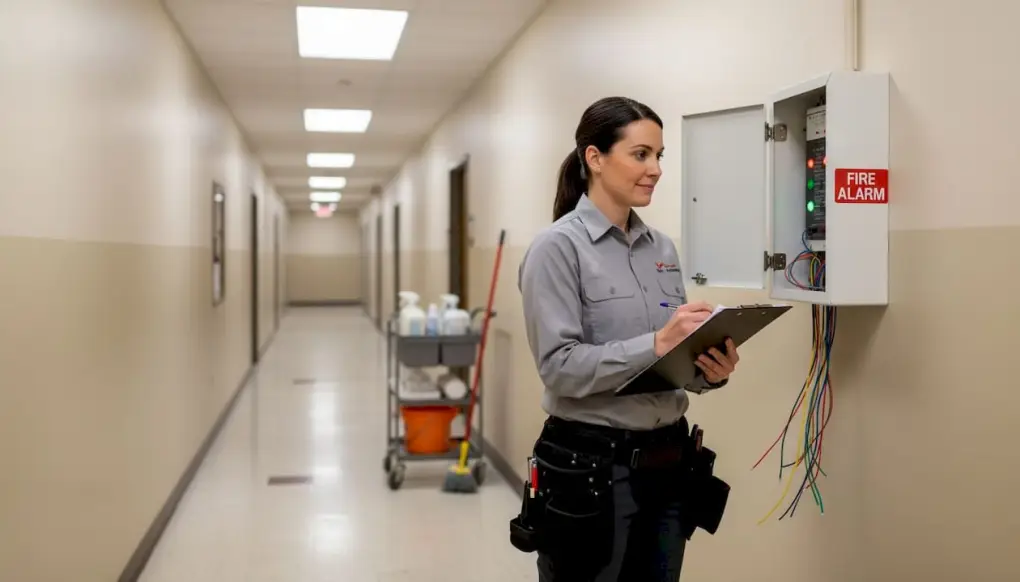
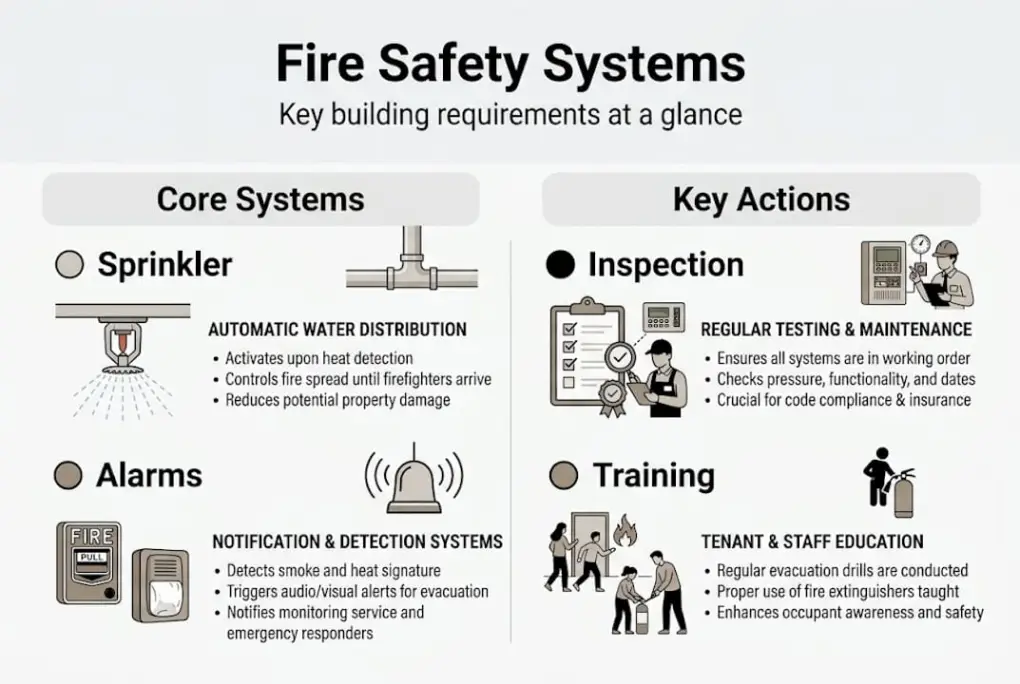
Inspection and testing schedules are set by three standards: NFPA 25 for water-based suppression systems, NFPA 72 for fire alarm systems, and OSHA regulations for portable fire extinguishers. Each has specific frequencies you must follow.
NFPA 25 requires monthly visual checks on sprinkler systems, quarterly and annual professional inspections, and five-year internal inspections of pipes. NFPA 72 requires quarterly testing of supervisory signals and annual testing of all alarm initiating and notification devices. OSHA mandates a monthly visual check of extinguishers and a professional annual maintenance service.
A practical inspection calendar looks like this:
- Monthly: Visual check of all fire extinguishers and sprinkler system components for obvious damage or obstructions
- Quarterly: Alarm supervisory signal tests (NFPA 72), sprinkler valve inspections (NFPA 25)
- Annually: Full alarm device testing, professional extinguisher maintenance, sprinkler flow tests
- Every 5 years: Internal pipe inspections and sprinkler obstruction investigations (NFPA 25)
Documentation rule: Every inspection, test, and maintenance action must be recorded in writing and kept on-site. AHJs routinely request these records during inspections. A missing log can result in the same fine as a missed inspection.
Pro Tip: Assign a named staff member as the fire safety point of contact. That person handles the monthly visual checks, keeps the inspection log updated, and is the first call when a contractor arrives for annual testing. Clear ownership prevents tasks from falling through the cracks.
Staff training is a legal requirement under OSHA, not a recommendation. Employees must know evacuation routes, the location of extinguishers, and how to report a fire. Drills must be documented. For larger properties, consider reviewing fire protection strategies that cover training frameworks and recordkeeping systems. You can also find guidance on NFPA 25 inspection schedules to stay on track with system-specific timelines.
Special cases and 2026 code updates
Standard code requirements cover most buildings well. But certain property types and recent code changes add another layer of responsibility that property managers need to watch closely.
High-rise buildings, defined as structures taller than 75 feet, face stricter requirements than low-rise properties. These include standpipes and enhanced communications systems, emergency voice/alarm communication, and additional egress stairwell pressurization. If you manage a high-rise, assume your requirements are materially different from any other building type.
Mixed-use buildings present a specific challenge. When a building contains both residential and commercial occupancies, codes generally apply the most restrictive rules from each category to the shared systems. That can mean sprinklers required throughout even if one occupancy group alone would not trigger the threshold.
Change of occupancy is another common trigger for upgrades. If a tenant moves out and a new tenant operates in a different use category, the building may require a full code review. Converting a storage space (Group S) to a restaurant (Group A-2) is a classic example that catches owners off guard.
Here is what to monitor going into 2026:
- NFPA 855 energy storage updates: The 2026 edition adds detailed requirements for battery energy storage systems (ESS). Buildings using large lithium-ion battery arrays for backup power or solar storage now face hazard analysis requirements, explosion control measures, and dedicated suppression systems.
- Local adoptions: Not every jurisdiction adopts the 2026 codes immediately. Check with your AHJ on the current adoption cycle.
- Insurance-driven requirements: Some insurers impose fire protection standards that exceed local code. Always review your policy alongside local requirements.
For multifamily properties specifically, multi-tenant housing requirements cover the key thresholds that apply to apartment buildings and mixed-use residential. You can also get updated fire alarm insights tailored to property managers navigating the 2026 landscape.
What most fire code articles miss: Coordinating for continual compliance
Most guides stop at listing requirements. The harder problem is staying compliant between inspections, across staff turnover, and through building changes.
The property managers who avoid costly violations share one habit: they treat compliance as a system, not an annual event. That means keeping inspection logs current, scheduling contractor visits before they are due, and briefing new staff on fire safety responsibilities during onboarding rather than waiting for the next drill.
Building a working relationship with your local AHJ is also practical, not just polite. Inspectors who know you take compliance seriously are more likely to flag issues informally before issuing citations. That kind of early warning is worth more than any single system upgrade.
Running regular drills matters more than most managers expect. A drill surfaces gaps in your evacuation plan that a paper review never would. Staff who have walked the route know it. Staff who have only read it often do not.
Going beyond the minimum is not just about passing inspections. It reduces real risk and often reduces insurance costs over time. Continual fire safety strategies can help you build that ongoing practice into your normal property operations.
Fire protection made simple with Security & Life Integrations
Putting all of these regulations into practice requires the right systems and a reliable partner who understands the codes that apply to your specific property.
Security & Life Integrations provides UL-certified professional fire alarm systems designed for commercial and multifamily properties. Whether you are upgrading an outdated panel, adding coverage after a renovation, or starting from the ground up, we design and install systems that meet current code requirements. Our team also supports multi-tenant fire protection with solutions built for the complexity of mixed-use and residential buildings. Contact Security & Life Integrations to schedule a no-pressure consultation and find out how we can simplify your compliance obligations as your all-in-one fire and life safety partner.
Frequently asked questions
What is the NFPA, and why does it matter for fire safety?
The NFPA (National Fire Protection Association) publishes fire safety standards that most states adopt as enforceable law through local building and fire codes, making it the primary technical reference for US compliance.
How often must fire extinguishers be inspected in commercial buildings?
Fire extinguishers require a monthly visual check by on-site staff and a professional annual maintenance service to meet OSHA 29 CFR 1910.157 requirements.
Are fire sprinklers mandatory in every commercial building?
No. Sprinklers are required for high-rises over 75 feet and certain occupancy types such as Group A-2 spaces with more than 300 occupants, but not all commercial buildings trigger the threshold.
What is the biggest compliance risk for building owners?
Blocked exits affect 71% of cited violations, making them the top enforcement issue, followed by insufficient sprinkler clearance at 18%, both of which carry significant fines.
How do new fire safety rules for energy storage systems affect my building?
The 2026 NFPA 855 updates impose new hazard analysis and suppression requirements for onsite battery energy storage systems, affecting any building using large-scale lithium-ion backup or solar storage arrays.