
TL;DR:
- Assuming security systems are fully functional if they are still running can lead to increased costs, legal liabilities, and vulnerabilities. Upgrading involves improving existing components, while replacements entail installing a new system entirely, often influenced by system age, support, and integration capabilities. Strategic phased upgrades in occupied facilities reduce disruption, improve security, and help ensure compliance with evolving regulations, ultimately saving costs and minimizing risks.
Most property managers assume that if a security system is still running, it’s still working. That assumption is costing them money, exposing them to legal liability, and leaving properties vulnerable in ways that aren’t always visible until something goes wrong. Understanding why upgrade security systems decisions matter means looking past the hardware that boots up every morning and asking what it can no longer do. This guide walks through the specific risks, costs, and compliance pressures driving upgrade decisions across multifamily, commercial, and institutional properties, and gives you a practical framework for acting on them.
Table of Contents
- Understanding security system upgrades versus replacements
- Cybersecurity risks and operational costs of legacy access control systems
- Reducing false alarm risks and costs with upgraded fire and alarm monitoring
- Phased modernization: practical strategies for upgrading occupied and complex facilities
- Compliance and legal risks driving security system upgrades in regulated properties
- The real cost of delay: why upgrading security systems is a strategic investment
- How Security & Life Integrations can help upgrade your property’s security
- Frequently asked questions
Key Takeaways
| Point | Details |
|---|---|
| Upgrades vs replacements | Upgrading extends system life by improving components, but replacement may be needed if performance or security gaps are large. |
| Cyber and operational risks | Legacy systems increase vulnerability and maintenance costs, making upgrades critical for protection and savings. |
| False alarm impact | Modern fire and alarm systems reduce costly false alarms and prevent emergency response suspensions. |
| Phased upgrade benefits | Phased modernization minimizes downtime and aligns improvements with budgets and operational needs. |
| Compliance requirements | Meeting fire and building codes through upgrades avoids legal risks and enhances occupant safety. |
Understanding security system upgrades versus replacements
To choose the best path, first understand the core difference between upgrading and fully replacing your security system.
An upgrade replaces or improves specific components within an existing system. You might swap out analog cameras for IP models, update access control software, or add cloud-based storage while keeping the core infrastructure in place. A full replacement means removing the existing system entirely and installing a new one from the ground up.
Upgrading extends infrastructure life by swapping components like cameras, software, and storage in stages, which reduces upfront cost. That staged approach is especially useful when budgets are fixed or when a property is occupied and cannot tolerate extended downtime.
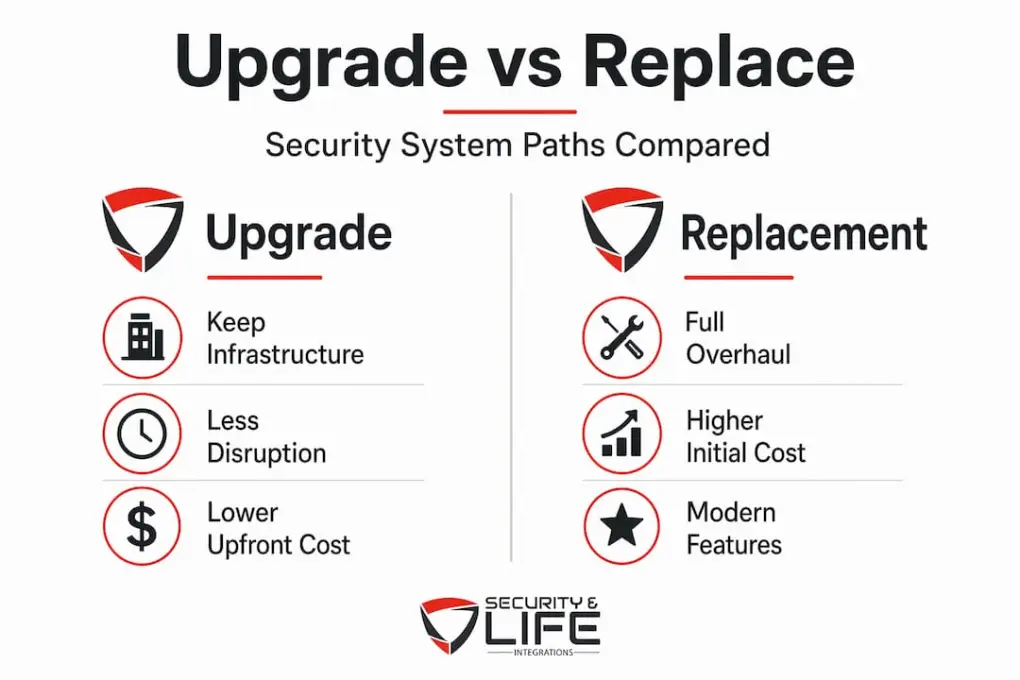
Upgrades have limits, though. If your system runs on discontinued software, unsupported hardware, or a proprietary platform with no upgrade path, you may be spending money to extend something that cannot be saved. The question to ask is whether the core architecture can support modern integrations. If it cannot, patching around it just delays a larger, more expensive problem.
Key factors that influence whether to upgrade or replace an access control system include:
- System age: Most commercial security systems have a practical lifespan of 7 to 10 years.
- Software support: Systems without active firmware or software updates are security liabilities regardless of physical condition.
- Integration capability: Older systems often cannot communicate with modern access control, surveillance, or fire alarm platforms.
- Maintenance frequency: If your team is calling for service more than twice a year on the same components, the cost math usually favors replacement.
- Vendor support: If the manufacturer no longer supports the product, you are operating without a safety net.
Pro Tip: Before committing to either path, ask your vendor for a written assessment of your current system’s integration capacity. Not every technician will volunteer this information without being asked directly.
Cybersecurity risks and operational costs of legacy access control systems
With a grasp of upgrade basics, it’s crucial to understand specific risks legacy access controls pose to security and budgets.
Legacy access control systems are a common weak point in otherwise well-managed properties. Many still rely on 125kHz proximity cards, which were designed decades before wireless hacking tools became widely available. Legacy systems using 125kHz prox cards can be cloned with inexpensive readers, lack firmware updates, and carry security gaps that increase maintenance costs over time.
The financial impact is not only from breaches. Maintenance costs for outdated systems grow by approximately 15% per year as parts become harder to source and technician expertise in older platforms becomes scarce. That escalation is steady and predictable, which makes it easy to ignore until it becomes significant.
“The longer you keep a legacy system in service, the more you pay to maintain it, and the less security value you get for that money.”
Modern access control solutions use encrypted credentials, multi-factor authentication, and cloud-based management that allows real-time access changes and audit logs. This matters for property managers because it means removing a former employee’s access or locking down a compromised entry point takes seconds, not a service call.
Phased upgrades work well here. You can start by replacing credential readers and cards at high-traffic entry points, update the management software, and then migrate interior doors and elevator access over subsequent quarters. This approach reduces upfront costs and keeps the property secure throughout the transition. For additional context on access control options for complex sites, access control solutions for gated and perimeter environments follow similar principles.
Reducing false alarm risks and costs with upgraded fire and alarm monitoring
Beyond access control, fire and alarm monitoring upgrades directly impact operational safety and cost management.
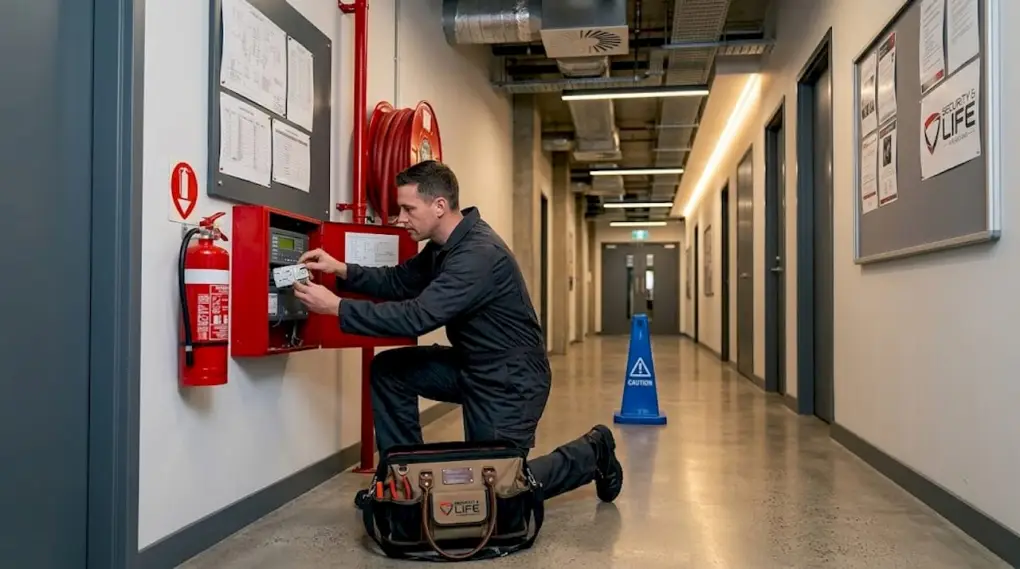
False alarms are not just a nuisance. They carry direct financial penalties that compound quickly. Cities across the country use tiered fee structures that escalate based on how often a property triggers an alarm within a rolling 12-month window.
How false alarm fees typically escalate:
- First alarm: No charge or a small administrative fee.
- Second alarm: Fee in the range of $50 to $100.
- Third alarm: Fee increases, often $100 to $250.
- Fourth and fifth alarms: Fees can reach $350 or more per event.
- Repeated alarms: Police or fire response may be suspended entirely.
False alarm fees escalate after repeated events, and police response can be suspended after multiple false alarms within a 12-month period, as documented in Tacoma’s alarm policy. A property that triggers false alarms frequently is not just paying fines. It is at risk of losing emergency response coverage entirely, which creates real liability.
| Number of false alarms | Approximate fee range | Risk level |
|---|---|---|
| 1 to 2 per year | $0 to $100 | Low |
| 3 to 4 per year | $100 to $500 | Moderate |
| 5 or more per year | $500+ and response suspension | High |
Upgraded fire alarm and monitoring systems reduce false alarms by improving sensor accuracy, adding event verification steps, and enabling remote monitoring that can assess an alarm before dispatching emergency services. The ROI on a monitoring upgrade is often measurable within the first year through avoided fees alone.
Pro Tip: Ask your current monitoring provider how many false alarms your property triggered last year. If you don’t know the number off the top of your head, your current system is not giving you enough visibility. A review of fire alarm system upgrades can clarify what detection and verification capabilities are now standard.
Phased modernization: practical strategies for upgrading occupied and complex facilities
Understanding tactical phased upgrades helps apply strategic improvements with minimal disruption in live environments.
Upgrading security in an occupied apartment building, hospital, or commercial office is not the same as installing a system in an empty space. Tenants, patients, employees, and visitors are present. Entrances must stay functional. Emergency systems cannot go dark.
Phased upgrades starting from the perimeter inward maintain uptime, minimize disruption, align with budgets, and deliver measurable ROI in operational facilities. The logic is straightforward: secure the outer boundary first, then work inward through common areas, and address interior zones last.
Key benefits of a phased approach include:
- Continuous protection: No gap in coverage at any stage of the project.
- Budget flexibility: Costs spread across fiscal quarters or years.
- Stakeholder input: Feedback from building staff and tenants can be applied between phases.
- Testing windows: Each completed phase can be evaluated before the next begins.
- Compliance alignment: Phasing allows time to verify code compliance at each layer before moving forward.
| Factor | Phased upgrade | Full replacement |
|---|---|---|
| Upfront cost | Lower, spread over time | Higher, paid at once |
| Disruption to occupants | Minimal per phase | Significant during full install |
| Integration risk | Lower, tested incrementally | Higher, all at once |
| Timeline | Longer overall | Shorter if unoccupied |
| Best for | Occupied or budget-constrained properties | Severely outdated or unsupported systems |
Property managers who handle fire and life safety for property management across multiple buildings often find that phased upgrades also allow them to standardize systems across a portfolio over time, reducing long-term training and maintenance costs.
Pro Tip: Build a simple upgrade map before starting. Diagram every entry point, camera location, and alarm zone. Assign each to a phase. This prevents scope creep and makes it easier to communicate progress to building owners, boards, or institutional stakeholders.
Compliance and legal risks driving security system upgrades in regulated properties
Alongside operational benefits, compliance mandates increasingly drive security system upgrade decisions in regulated sectors.
Regulations around access control and fire safety are becoming more specific, not less. Ontario’s 2026 compliance requirements for access control systems include specific wiring standards, egress unlock timing, locking hardware compatibility with fire alarm integration, annual inspection records, and event documentation that fire marshals can verify on demand.
Properties that do not meet these requirements face:
- Failed fire marshal inspections
- Insurance coverage disputes or premium increases
- Legal liability in the event of a fire or security incident
- Fines tied to building code violations
Documentation is not optional. Compliance in regulated environments requires that event logs, including door access events tied to CCTV timestamps, are available during inspections. Legacy systems often cannot produce this level of documentation. They may log events locally without cloud backup, use formats that are not readable by current compliance tools, or fail to timestamp events with the precision inspectors require.
Key compliance areas for access control upgrades in 2026 include:
- Wiring standards: Systems must use wiring types that meet current fire and building code.
- Egress capability: Access control doors must unlock within required time windows when a fire alarm activates.
- Annual inspections: Documented inspections must be completed and records retained.
- Event logging: Logs must be verifiable and accessible to fire marshals and insurance auditors.
| Compliance area | Legacy system capability | Modern system capability |
|---|---|---|
| Egress unlock on fire alarm | Often manual or delayed | Automatic, code-specified timing |
| Event log format | Local, proprietary | Cloud-based, exportable |
| Wiring compliance | May not meet 2026 standards | Installed to current code |
| Inspection documentation | Paper-based or incomplete | Digital, timestamped records |
Property managers overseeing fire protection for multi-tenant housing should treat compliance not as a checkbox but as an ongoing operational process. Systems that fall out of compliance mid-lease cycle can create significant liability exposure.
The real cost of delay: why upgrading security systems is a strategic investment
The most common reason property managers delay security upgrades is upfront cost. That reasoning is understandable, but it does not hold up against the actual numbers.
Delaying upgrades leads to higher maintenance costs and increased operational risk that often exceeds the upfront expense of modernization. This is not a theory. It reflects what happens in practice when aging systems demand more frequent service calls, fail during critical periods, or create compliance gaps that trigger penalties.
There is also an invisible cost that rarely shows up on a maintenance ledger: staff time spent managing workarounds for systems that do not function as intended. When a door controller fails and a technician must be called at night, the invoice is visible. When a building manager spends two hours resetting a system that should reset automatically, that cost is absorbed silently. These costs add up, and they rarely appear in the budget conversation about whether to upgrade.
The strategic case for upgrading is also about capability. Modern systems give you data that older systems cannot. You can see which entry points are used most frequently, identify patterns that suggest tailored access policies, and generate reports that simplify insurance renewals and compliance audits. That is not a feature list. That is operational intelligence that helps you manage the property more effectively.
The question worth asking is not “Can we afford to upgrade?” It is “What does it actually cost us each year to avoid it?” When you factor in maintenance escalation, compliance risk, false alarm fees, and the liability exposure from a breach or inspection failure, the math tends to favor action. Reviewing your current system’s condition against a replacement or upgrade assessment is a reasonable first step.
How Security & Life Integrations can help upgrade your property’s security
Security & Life Integrations works with property managers and building owners across multifamily, commercial, and institutional sectors to plan and implement security system upgrades that match real operational needs.
Whether you need fire alarm system upgrades that meet current code requirements, modern access control installations that replace outdated proximity card systems, or video surveillance systems with high-definition cameras and cloud storage, the company provides customized solutions rather than off-the-shelf packages. The team supports phased upgrade planning that aligns with your budget cycle and minimizes disruption to occupants. With 24/7 support and experience across property types, Security & Life Integrations can assess your current system, identify gaps, and outline a practical upgrade path that addresses compliance, security, and cost.
Frequently asked questions
How do I know if my security system needs an upgrade or a full replacement?
If your system has declining video quality, lacks software updates, or requires frequent service calls, targeted upgrades may help. But when system performance and reliability continue to decline despite upgrades, full replacement is usually the more cost-effective path.
What security risks come with using legacy access control systems?
Older systems often rely on credentials that are easy to clone, and many 125kHz prox cards lack security patches, leaving your property exposed to both physical and cyber threats.
How can upgrading fire alarm systems reduce false alarm fees?
Modern monitoring systems use detection verification before triggering a dispatch, which directly reduces false alarm frequency. Repeated false alarm events escalate fees and can lead to suspended emergency response coverage.
Why is phased upgrading recommended for occupied facilities?
Phased upgrades keep the property protected at every stage while spreading costs across budget cycles. Starting at the perimeter and moving inward minimizes disruption to tenants and operations while delivering measurable security improvements at each phase.
What compliance risks do outdated access control systems pose in regulated regions?
Outdated systems may not meet current egress, wiring, or documentation standards. Ontario’s 2026 code requirements illustrate how specific these mandates have become, and non-compliance can result in failed inspections, insurance issues, and legal exposure.