
TL;DR:
- Properly managed surveillance cameras can significantly reduce property crime and improve operational security.
- Integrated security systems combining cameras, lighting, and access control provide the best protection.
- Regular audits, maintenance, and legal compliance are essential for effective and lawful surveillance.
A retail manager once reviewed footage after a break-in, only to find the camera had been angled at the wrong wall for months. No useful footage. No leads. Just a costly lesson in what happens when surveillance is treated as a checkbox rather than a working system. Many property managers install cameras and assume the job is done. The reality is more nuanced. Surveillance cameras can reduce property crime by up to 51% in specific environments, but only when deployed and managed correctly. This guide covers the real benefits, the data behind effectiveness, legal responsibilities, and how to build a system that actually works.
Table of Contents
- Understanding the core benefits of surveillance cameras
- Comparing surveillance camera effectiveness: What the data tells us
- Integrating surveillance cameras with broader security strategies
- Privacy, compliance, and new risks with surveillance cameras
- Why most property owners misuse surveillance cameras
- Secure your property with expert camera solutions
- Frequently asked questions
Key Takeaways
| Point | Details |
|---|---|
| Proven crime deterrence | Surveillance cameras substantially reduce property crime, especially when part of a complete security plan. |
| Integration is essential | Cameras work best alongside alarms, lighting, and regular monitoring for active protection. |
| Legal compliance required | Proper signage, privacy respect, and regular policy review are crucial to avoid legal trouble. |
| Ongoing maintenance matters | Frequent testing and system audits maximize camera effectiveness and minimize risk. |
Understanding the core benefits of surveillance cameras
Surveillance cameras serve two distinct functions for property managers and business owners: deterrence and documentation. Deterrence works by making would-be offenders aware they are being watched. Documentation creates a record that supports investigations, insurance claims, and legal proceedings. Both functions have measurable value, but neither works without proper planning.
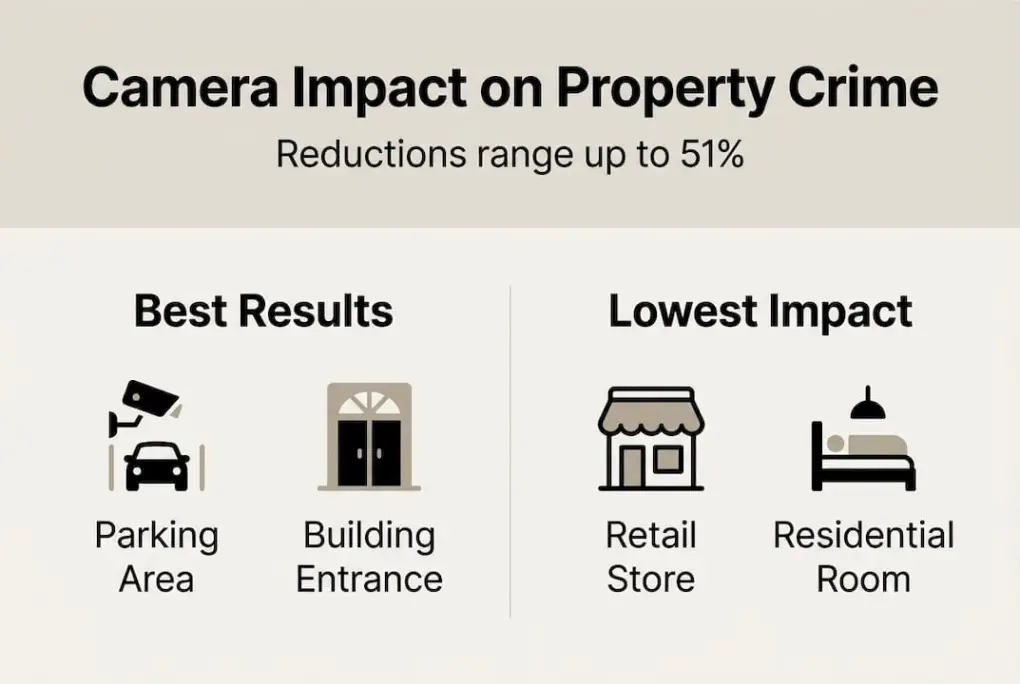
Meta-analyses show CCTV reduces overall crime by 13-16%, with stronger effects on property crimes, vehicle theft, and drug offenses. In parking areas specifically, reductions reach 30-51%. These numbers matter because they translate directly into fewer incidents, lower repair costs, and reduced legal exposure for property owners.
Beyond crime reduction, cameras provide operational benefits that are easy to overlook:
- Incident verification: Cameras resolve disputes between tenants, staff, or customers quickly and objectively.
- Staff accountability: Employees perform more consistently when they know activity is recorded.
- Insurance savings: Many insurers offer premium reductions for properties with documented surveillance systems.
- Liability protection: Footage can defend against false claims or confirm the sequence of events in an accident.
- Perception of safety: Tenants and employees feel more secure, which supports retention and satisfaction.
The impact also varies by property type. Parking structures, building entrances, and high-value storage areas show the strongest results. Open public spaces or areas with low foot traffic tend to see weaker effects. Understanding where cameras add the most value helps you allocate your budget effectively.
| Property area | Crime reduction potential | Notes |
|---|---|---|
| Parking lots | 30-51% | Strongest documented results |
| Building entrances | Moderate to high | Works well with access control |
| Retail floors | Moderate | Best with active monitoring |
| Open public areas | Low to moderate | Needs complementary measures |
| Storage and server rooms | High | Deters internal theft |
Pro Tip: Pair your camera placement review with a video surveillance for property management audit to identify blind spots before an incident forces the issue.
For multi-unit properties, the benefits extend further. Security cameras for multi-tenant housing help property managers document access patterns, resolve neighbor disputes, and meet insurance requirements, all from a centralized system.

Comparing surveillance camera effectiveness: What the data tells us
Not all camera deployments produce the same results. The evidence is clear on where cameras work best and where expectations need to be adjusted.
CCTV reduces property crimes by 30-51% in parking areas, which represents some of the strongest results recorded in peer-reviewed research. Cameras at controlled entry points, loading docks, and high-value storage areas also perform well. These are environments where offenders have time to weigh the risk of being caught.
Violent crime and public disorder are different. Cameras have a weaker effect on impulsive acts or situations where the offender is not thinking rationally about consequences. This does not mean cameras are useless in those settings, but it does mean you should not rely on them as your primary tool for managing confrontational situations.
One finding that surprises many property managers: effects decay after 3-11 years without active management. Offenders adapt. Technology ages. Coverage gaps develop. A system that was effective in 2018 may have significant blind spots today if it has not been reviewed and updated.
“Stand-alone cameras are less effective if not integrated with active monitoring and complementary security measures.”
The research on CCTV effectiveness and privacy also notes that displacement is a real concern. Cameras may push crime to adjacent areas rather than eliminating it entirely. This is a reason to think about coverage holistically rather than focusing only on the highest-risk spot.
| Crime type | Camera effectiveness | Key condition |
|---|---|---|
| Parking lot theft | High | Visible cameras, good lighting |
| Vehicle break-ins | High | Wide-angle coverage |
| Retail shoplifting | Moderate | Active monitoring required |
| Violent crime | Low to moderate | Needs human response |
| Drug offenses | Moderate | Best in controlled areas |
For specialized environments, the calculus changes. Security cameras in assisted care facilities must balance resident safety with strict privacy requirements. Security cameras in schools are most effective at entrances and perimeters rather than inside classrooms. And license plate camera benefits extend beyond crime deterrence to include vehicle access management and documentation for insurance claims.
Integrating surveillance cameras with broader security strategies
Standalone CCTV is less effective than cameras integrated with other security measures. This is one of the most consistent findings across surveillance research. Cameras work best as one layer in a system, not as the entire system.
Here is a practical framework for building an integrated security plan:
- Map your risk zones. Identify where incidents are most likely to occur, including entry points, parking areas, and high-value storage.
- Add lighting. Cameras require adequate light to capture usable footage. Poor lighting is one of the most common reasons footage fails in investigations.
- Install access control. Video entry and access control systems restrict who can enter sensitive areas and create a digital log that complements camera footage.
- Connect alarms. Integrating cameras with burglary alarms allows for immediate notification when a camera detects motion in a restricted area after hours.
- Establish a response plan. Footage is only useful if someone reviews it and acts on it. Define who gets notified, how fast, and what steps follow an alert.
- Schedule regular audits. Review camera angles, test recording quality, and update firmware at least once a year.
CCTV’s modest overall impact is contextual; cameras work best when actively integrated with patrols and lighting rather than left to operate passively.
Pro Tip: After any incident on your property, conduct a camera review within 24 hours. This habit builds institutional knowledge about coverage gaps and helps you justify future upgrades with documented evidence.
A common real-world example: a property manager at a 200-unit apartment complex paired license plate readers at the entrance with interior cameras and a 24-hour monitoring contract. Reported vehicle thefts dropped significantly within the first year, and insurance premiums followed.
Key elements to include in your integrated security plan:
- Visible and covert cameras in layered positions
- Motion-activated lighting at all entry points
- Access control logs synced with camera timestamps
- Staff training on how to report and document incidents
- A written incident response protocol reviewed annually
Privacy, compliance, and new risks with surveillance cameras
Installing cameras without understanding the legal framework is a significant risk. Privacy laws prohibit cameras in private areas and require signage, consent for audio recording, and limits on how long footage is stored. Violations can result in fines, lawsuits, and reputational damage.
The basic rules every property manager should know:
- No cameras in private areas. Bathrooms, changing rooms, and employee break rooms are off-limits in virtually every jurisdiction.
- Post visible signage. Most states require clear notice that surveillance is in use. This also reinforces deterrence.
- Audio recording requires consent. Many states require all parties to consent before audio is recorded. Video-only systems avoid this complication in most cases.
- Set data retention limits. Storing footage indefinitely creates liability. Define how long recordings are kept, typically 30 to 90 days, and automate deletion.
- Limit access to footage. Only authorized personnel should be able to view or export recordings.
“While effective for property crimes, CCTV raises privacy and liability risks if systems are not compliant with applicable law.”
Regular policy review is not optional. Laws change, and what was compliant three years ago may not meet current standards. This is especially relevant as AI-based analytics and facial recognition features become more common in commercial camera systems.
For faith-based properties, the compliance picture has unique dimensions. Church camera installation guidance covers how to balance congregant privacy with security needs, including where cameras are appropriate and how to communicate their presence to the community.
Why most property owners misuse surveillance cameras
After years of working with property managers across residential, commercial, and institutional settings, one pattern stands out: most owners treat cameras as a passive tool. They install the system, forget about it, and assume it is working. It usually is not, at least not at full capacity.
The false sense of security is the biggest risk. A camera that has not been audited in two years may have a dead sensor, a shifted angle, or outdated firmware that leaves footage corrupted. You will not know until you need the footage most.
Many owners also skip the response side entirely. A camera records an incident. Nobody reviews the footage for 72 hours. The window for action closes. The value of the system collapses.
The properties that get the most from their surveillance investment treat it like any other operational system. They schedule ongoing camera maintenance, train staff on incident documentation, and review coverage maps annually. They also combine cameras with fast repair cycles so blind spots do not persist. That is where real security value lives, not in the hardware alone.
Secure your property with expert camera solutions
Understanding the data and the legal requirements is the first step. Applying them correctly across your specific property type is where most managers need support.
Security & Life Integrations designs and installs video surveillance solutions tailored to your property’s layout, risk profile, and compliance requirements. From video monitoring services that ensure someone is always watching, to specialized systems for multi-tenant security cameras, we handle design, installation, and ongoing support. You get a system that works on day one and stays effective over time, without the guesswork.
Frequently asked questions
Do surveillance cameras actually reduce crime?
Yes. CCTV reduces overall crime by 13-16% on average, with property crime reductions reaching up to 51% in high-performing environments like parking lots.
Are there legal risks to installing cameras in my business?
Yes. Privacy laws restrict camera placement in private areas and require proper signage, audio consent, and defined data retention limits to avoid liability.
How do I get the most value out of surveillance cameras?
Standalone CCTV is less effective than cameras paired with lighting, alarms, access control, and a defined human response plan. Integration is what drives results.
How often should surveillance systems be updated or audited?
At minimum, annually. Effects decay after 3-11 years without maintenance, so regular reviews of coverage, firmware, and recording quality are essential to keeping your system reliable.
Recommended
- Security Cameras for Multi-Tenant Housing | Security & Life Integrations
- Elevating Property Management: The Power of Video Surveillance | Security & Life Integrations Inc % %
- Enhancing Multi-Tenant Housing Security with License Plate Cameras
- Security Cameras for Religious Buildings & Churches | Security & Life Integrations Inc
- Public Safety Risk Reduction 2026: Cut Crime 20% Fast
- Physical Surveillance Explained: Key Skills for UK Security