

TL;DR:
- Monitored fire systems connect detectors to a central station for verification and emergency response. They reduce false alarms, improve compliance, and lower insurance premiums. Regular system reviews and upgrades are essential for ongoing safety and legal adherence.
Most property managers assume that installing a fire alarm is enough to protect their building and satisfy code requirements. That assumption is wrong. A standard alarm makes noise when smoke is detected, but it does not verify the event, notify emergency services, or log the incident for compliance records. False alarms are common, and without a verification step, response delays are almost guaranteed. Monitored fire systems fill that gap. This guide explains how they work, how they compare to unmonitored alarms, how they reduce false alerts, and why they matter for compliance and liability.
Table of Contents
- What is a monitored fire system?
- Monitored vs. unmonitored fire alarms: Key differences
- Reducing false alarms: Modern strategies
- Compliance and response times: How monitoring makes a difference
- Why property managers shouldn’t treat fire alarms as ‘set-and-forget’
- Explore monitored fire systems for your property
- Frequently asked questions
Key Takeaways
| Point | Details |
|---|---|
| Continuous monitoring matters | Monitored fire systems ensure verified responses, reducing missed alarms and compliance risk. |
| False alarm reduction | Modern sensors and verification delays dramatically minimize nuisance triggers and ignored alerts. |
| Insurance and safety benefits | Monitoring can lower insurance costs and prevent major property losses through faster response. |
| Code compliance simplified | Monitored systems support regulatory requirements and protect businesses from costly citations. |
What is a monitored fire system?
A monitored fire system connects your building’s detectors directly to a remote central station staffed by trained professionals. When a detector activates, a signal travels to that station. An operator then reviews the alert, attempts to verify it, and contacts emergency services if the situation warrants a response. This process removes the burden from building occupants and eliminates the gap that exists when no one is on-site to act.
The core components of a monitored fire system include:
- Smoke and heat detectors: Placed throughout the property to detect early signs of fire
- Control panel: The brain of the system, receiving signals from all detectors and routing alerts
- Communication device: Sends alarm data to the central station via cellular, internet, or phone line
- Central monitoring station: Staffed 24/7 to receive, verify, and act on incoming alerts
- Notification systems: Sirens, strobes, and automated calls to alert occupants and authorities
The central station monitoring process is what separates monitored systems from basic alarms. When a signal comes in, operators follow a set protocol. They check for a valid alarm, attempt to reach a designated contact at the property, and dispatch fire services if they cannot confirm a false trigger. This step-by-step verification is why monitored systems verify alarms before dispatch to minimize unnecessary emergency responses.
For property managers, this matters on multiple levels. First, it reduces the number of times fire trucks show up for a burnt piece of toast. Second, it creates a documented record of every alarm event, which supports compliance reporting. Third, it ensures that when a real fire occurs, help is on the way even if the building is empty or occupants are unable to call for help.
Commercial properties and multi-tenant housing face strict fire code requirements. A monitored system is often not just a best practice but a legal requirement. The system provides the reliability and accountability that local authorities and insurance carriers expect to see.
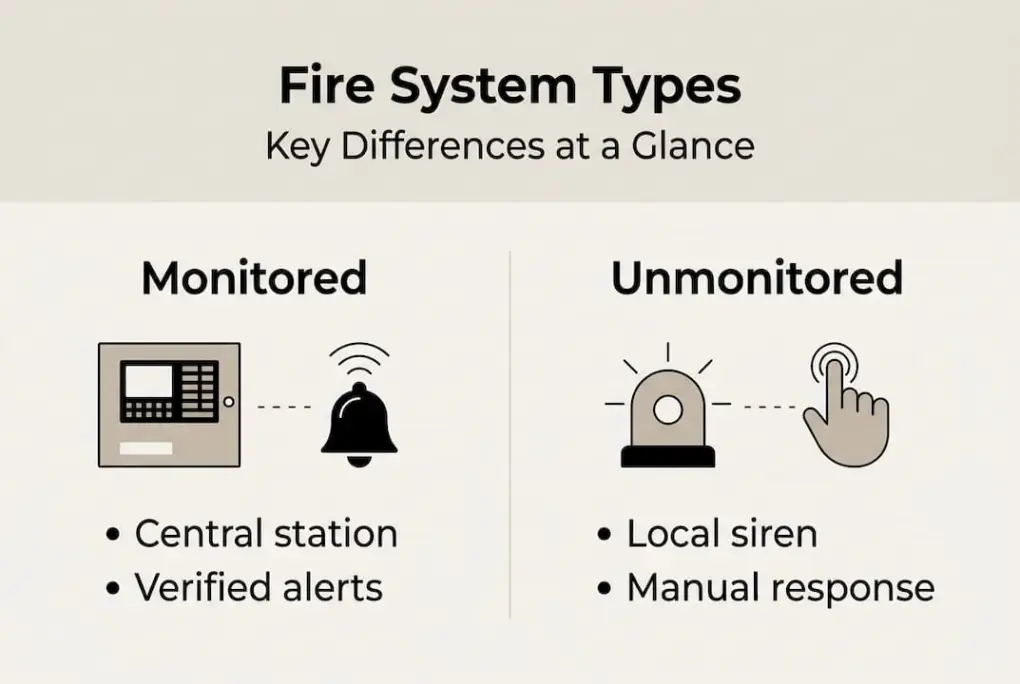
Monitored vs. unmonitored fire alarms: Key differences
An unmonitored fire alarm does one thing: it makes noise. It relies entirely on someone hearing that noise, recognizing the emergency, and calling 911. That chain of events works well when the building is occupied and everyone is awake. It fails when the building is empty, when occupants are asleep, or when the alarm has been triggered so many times before that people ignore it.
Monitored fire alarms operate differently. The alarm still sounds, but a parallel process kicks in at the central station. Even if every occupant ignores the alarm or evacuates without calling for help, the monitoring center is already working the problem.

| Feature | Monitored system | Unmonitored system |
|---|---|---|
| Emergency dispatch | Automatic via central station | Requires occupant to call 911 |
| Alarm verification | Yes, by trained operators | No |
| Response when building is empty | Covered | No coverage |
| Compliance documentation | Logged and reportable | Manual or unavailable |
| Insurance premium impact | Often reduced | Minimal impact |
| False alarm management | Verification reduces dispatches | All alarms trigger full response |
For multi-tenant fire protection, the gap between these two options is significant. In a 50-unit apartment building, an unmonitored alarm depends on one of 50 households hearing it and acting. A monitored system removes that dependency entirely.
The London Fire Brigade GN54 notes that monitored systems reduce insurance premiums and support faster response. Insurance carriers recognize that monitoring reduces risk. Faster response means less property damage, fewer injuries, and smaller claims. That translates directly into lower premiums for property owners who invest in monitoring.
Pro Tip: Contact your insurance carrier before upgrading your fire alarm system. Many providers offer premium discounts of 5% to 20% for properties with UL-listed monitored systems. Get that confirmed in writing before you finalize your system choice.
Reducing false alarms: Modern strategies
False alarms are a real operational problem. When alarms trigger without cause, occupants stop taking them seriously. That behavioral shift is dangerous. It also creates friction with local fire departments, which may charge fees for repeated false responses.
Common causes of false alarms in commercial and residential properties include:
- Dust accumulation inside detector chambers
- Steam from showers, kitchens, or HVAC systems
- Insects entering the detector housing
- Cooking smoke from nearby units or break rooms
- Rapid temperature changes near vents or windows
Verification delays and dual-tech sensors are the two most effective tools modern monitored systems use to address these triggers. A verification delay gives the system a short window, typically 15 to 60 seconds, to confirm that a signal is sustained before escalating. If the detector resets on its own, the event is logged but not escalated.
Dual-technology sensors combine two detection methods in one unit. For example, a photoelectric sensor detects slow, smoldering fires while an ionization sensor picks up fast-flaming fires. When both sensors must agree before triggering an alarm, the rate of nuisance activations drops sharply.
| Strategy | How it works | Best for |
|---|---|---|
| Verification delay | Short wait before escalation | Dusty or humid environments |
| Dual-technology sensors | Two detection methods required | High-traffic commercial spaces |
| Strategic placement | Avoid HVAC vents and kitchens | Multi-unit residential buildings |
| Regular maintenance | Clean detectors, test monthly | All property types |
NFPA guidelines allow for short alarm verification delays in certain occupancy types, provided the delay does not compromise life safety. Your fire alarm maintenance schedule plays a direct role here. Dirty detectors are the leading cause of nuisance alarms, and a quarterly cleaning routine can cut false trigger rates significantly.
Pro Tip: Keep a log of every alarm event, including the time, location, and cause. After 90 days, patterns become visible. You may find that one detector in the laundry room accounts for 60% of your false alarms, which points directly to a placement or sensitivity issue.
Compliance and response times: How monitoring makes a difference
Fire codes are not suggestions. NFPA 72, the National Fire Alarm and Signaling Code, sets minimum standards for alarm system design, installation, and monitoring. Local jurisdictions often layer additional requirements on top of those standards. For commercial properties and multi-tenant housing, compliance is not optional.
Monitored systems support compliance in several concrete ways:
- They create a time-stamped record of every alarm event
- They document operator actions taken during each event
- They provide evidence that emergency services were notified promptly
- They support annual inspection reports required by local fire marshals
- They reduce liability exposure when incidents are investigated after the fact
Response time is where monitoring creates the most measurable impact. NFPA 1710 benchmarks turnout time at 80 seconds and travel time at 240 seconds, for a total target response of about 5 minutes and 20 seconds. Every second that passes before emergency services are notified adds to that clock. A monitored system starts the notification process immediately, without waiting for an occupant to dial 911.
Commercial properties in the U.S. generate approximately 52,000 alarm activations annually, with roughly 99% classified as false alarms. That volume highlights exactly why verification before dispatch is not just helpful but necessary for fire departments to maintain readiness for real emergencies.
For property managers, the compliance picture extends beyond the fire code itself. Review your fire alarm compliance guide to understand the full scope of documentation and inspection requirements. The costs of property management related to fire incidents, including fines, liability claims, and remediation, are far higher than the ongoing cost of a monitored system.
Why property managers shouldn’t treat fire alarms as ‘set-and-forget’
Most property managers install a fire alarm system, pass the inspection, and move on. The system gets tested once a year, maybe, and that is the end of the conversation. This approach works until it doesn’t.
Fire alarm technology, monitoring protocols, and code requirements all change over time. A system installed in 2015 may not meet 2026 standards. A monitoring contract that seemed adequate at signing may lack features that are now standard practice. Treating fire safety as a one-time task creates a slow drift toward non-compliance and reduced effectiveness.
The smarter approach is to treat your monitored fire system as an active tool, not a passive fixture. Review alarm logs quarterly. Ask your monitoring provider for performance reports. When codes are updated, assess whether your current system still qualifies. Upgrade sensors and communication hardware on a planned schedule rather than waiting for a failure.
Investing in advanced fire alarm solutions that include ongoing monitoring and regular system reviews is not an added expense. It is the baseline cost of running a compliant, low-risk property.
Pro Tip: Set a calendar reminder every six months to review your alarm event log with your monitoring provider. Ask specifically about any trends in false alarms, communication failures, or delayed signals. Small issues caught early are far cheaper to fix than compliance violations caught during an inspection.
Explore monitored fire systems for your property
If this article has prompted you to look more closely at your current fire safety setup, that is a productive first step. A basic alarm that makes noise is not the same as a system that verifies, documents, and responds.

Security & Life Integrations works with property managers and business owners to assess existing systems, identify compliance gaps, and implement monitored fire protection that meets current code requirements. Whether you manage a single commercial building or a portfolio of multi-tenant properties, the right fire alarm solutions make a measurable difference in safety outcomes and liability exposure. Explore multi-tenant fire protection options or review the full safety compliance guide to understand what your property actually needs.
Frequently asked questions
How does a monitored fire system work?
A monitored fire system detects smoke or heat, sends a signal to a central station, and trained operators verify before dispatch before notifying emergency services. This process runs automatically, regardless of whether anyone is present in the building.
Can monitored fire systems reduce false alarms?
Yes. Dual-tech sensors and placement strategies, combined with verification delays, significantly reduce false alarm rates from common triggers like dust, steam, and cooking smoke.
Are monitored fire systems required for commercial properties?
Many local fire codes and state regulations require monitored systems for commercial occupancies. Compliance with fire codes mandates reliable, documented alarm response, which unmonitored systems cannot provide.
Does monitoring affect insurance premiums?
Monitored systems reduce premiums by demonstrating lower risk to carriers. Faster verified response times and documented alarm histories make insured properties more favorable to underwriters.