
TL;DR:
- Well-designed video surveillance can reduce property incidents by up to 80 percent.
- Modern systems rely on strategic placement, analytics, and compliance to maximize effectiveness.
- Proper planning, signage, and privacy protections are essential for legal and operational success.
Video surveillance cuts property incidents by 60 to 80%, yet many property managers still treat cameras as a passive afterthought. The reality is that a well-designed system is one of the most cost-effective risk management tools available today. This guide walks you through what video surveillance actually is, how it works, which components matter, what the data says about outcomes, and what compliance requirements you need to meet. Whether you manage an HOA, a commercial building, or a multifamily property, the information here gives you a clear framework to make informed decisions.
Table of Contents
- Defining video surveillance: Purpose and principles
- Key components and technologies of modern systems
- How video surveillance works: Methodologies and analytics
- Benefits and proven outcomes for properties
- Privacy, compliance, and best practices
- Our perspective: What most leaders miss about video surveillance
- Enhance your property’s security with expert solutions
- Frequently asked questions
Key Takeaways
| Point | Details |
|---|---|
| Core definition | Video surveillance protects properties through electronic monitoring, deterrence, and evidence gathering. |
| Smart system benefits | Modern IP and AI-enabled systems deliver scalable, actionable security and proven ROI for property managers. |
| Operational workflow | Surveillance integrates cameras, recorders, analytics, and management software for round-the-clock coverage. |
| Compliance essentials | Effective security requires balancing privacy, legal obligations, and clear policies for video use and retention. |
Defining video surveillance: Purpose and principles
Video surveillance is far more than a row of cameras on a wall. At its core, it is a structured system for monitoring, recording, and analyzing activity in physical spaces. According to the Department of Homeland Security, video surveillance systems (VSS), also known as CCTV, are electronic assemblies used for deterrence, detection, and evidence collection. That three-part definition matters because it shifts the conversation away from simple watching toward active risk management.
Property managers often assume surveillance is just about catching people after an incident. That assumption costs time and money. The real value lies in prevention. When potential offenders see cameras placed at entry points, parking areas, and common spaces, behavior changes before anything happens. Detection adds a second layer, alerting staff or monitoring centers to activity in real time. Evidence collection then supports legal action, insurance claims, and internal investigations.
For HOAs and commercial properties, the practical functions of video surveillance include:
- Monitoring access points and common areas around the clock
- Verifying the identity of visitors and contractors
- Documenting policy violations such as unauthorized parking or property damage
- Supporting liability defense in slip-and-fall or dispute claims
- Providing data to guide staffing and operational decisions
A useful way to think about this: surveillance is infrastructure, not equipment. Just as you would not install a fire suppression system without a plan, you should not install cameras without defining what problems they are solving. An overview of surveillance systems confirms that purpose-driven design consistently outperforms random camera placement.
“The most effective surveillance programs are built around clearly defined security objectives, not around the number of cameras installed.”
For property managers focused on property crime reduction, starting with clear objectives is the single biggest differentiator between systems that deliver results and those that collect dust. Understanding these principles sets the foundation for every decision that follows, from camera type to data retention.
Key components and technologies of modern systems
Knowing what a system is supposed to do is only half the picture. You also need to know what it is made of. The core components of any video surveillance system include cameras (fixed, PTZ, analog, IP), recorders, transmission systems, and video management software (VMS). Each part plays a specific role, and choosing the wrong one for your property type creates gaps in coverage or unnecessary cost.
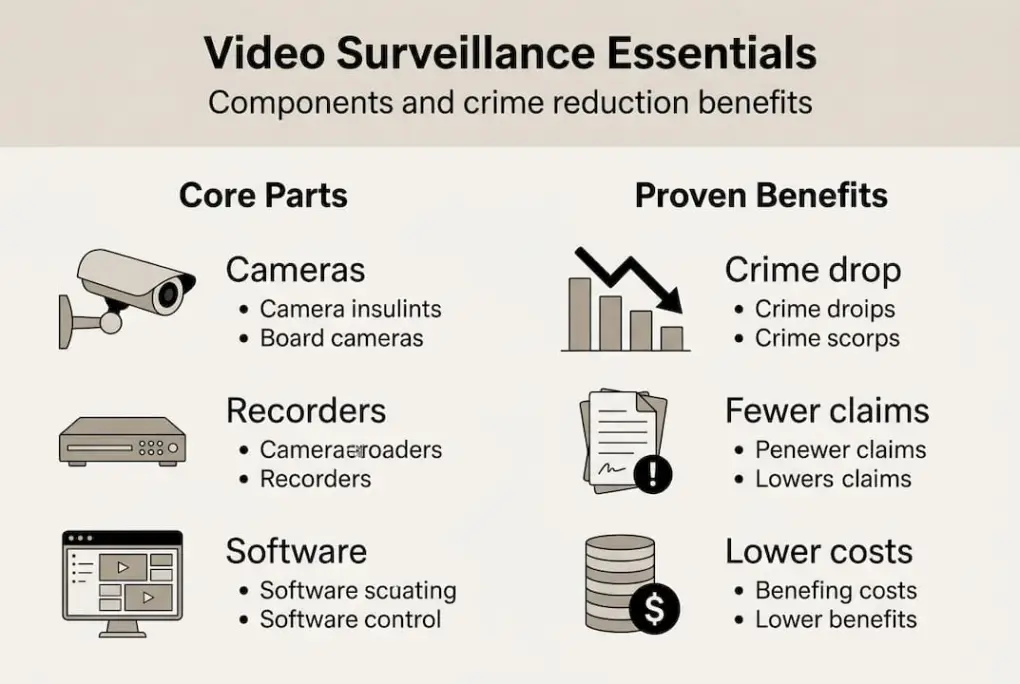
Cameras are the entry point. Fixed cameras cover a defined angle, while PTZ (pan, tilt, zoom) cameras allow operators to adjust the field of view remotely. Analog cameras send uncompressed signals over coaxial cables. IP cameras digitize footage at the source, enabling compression, remote access, and integration with analytics software.
Recorders store footage. Digital video recorders (DVRs) pair with analog cameras. Network video recorders (NVRs) pair with IP cameras and can connect to cloud storage for off-site backup.
Video management software (VMS) is the brain of the operation. It organizes feeds, triggers alerts, manages storage, and enables search. Modern VMS platforms also support edge AI, which runs analytics directly on the camera rather than sending raw footage to a server.
| Feature | Analog cameras | IP cameras |
|—|—|—|
| Image quality | Standard definition | High definition to 4K |
| Scalability | Limited by cable runs | Flexible over network |
| Remote access | Requires additional hardware | Built-in |
| Analytics support | Minimal | Full AI and VMS integration |
| Cost per camera | Lower upfront | Higher upfront, lower long-term |
For most properties installing or upgrading today, IP cameras with VMS are the practical choice. They support multi-tenant security cameras across large layouts without expensive rewiring. Edge AI capabilities reduce bandwidth demands and improve accuracy.
Pro Tip: Before you decide how many cameras to buy, map your property and identify the highest-risk zones. Camera quality in critical areas beats quantity spread thin across the whole site. If you need guidance on placement, resources on how to install surveillance cameras walk through site-specific decision criteria.
How video surveillance works: Methodologies and analytics
Understanding signal flow helps you ask better questions when evaluating vendors or troubleshooting system performance. Here is how footage moves from a physical space to a usable record:
- Capture: A camera’s image sensor detects light and converts it to a signal, either analog or digital.
- Transmission: Analog signals travel over coaxial cable to a DVR. IP signals compress and travel over ethernet or fiber to an NVR or cloud platform.
- Recording: The recorder stores footage based on defined rules, continuously, on motion trigger, or on schedule.
- Storage: Footage sits on local drives, a NAS device, or cloud servers with defined retention windows.
- Retrieval: Operators search footage manually or use VMS tools to locate events by time, zone, or triggered alert.
Where modern systems diverge sharply from older setups is at the analytics layer. Analog transmits uncompressed to DVR, while IP compresses and streams to NVR or cloud. Edge AI then supports object detection and false alarm reduction directly at the camera.
| Workflow stage | Analog system | IP with edge AI |
|---|---|---|
| Signal type | Uncompressed analog | Compressed digital |
| Storage device | DVR | NVR or cloud |
| Alert capability | Manual review only | Automated AI detection |
| False alarm rate | High | Significantly reduced |
For property managers, the practical benefit of AI-powered surveillance is fewer wasted hours. Instead of reviewing hours of footage after an incident, the system flags relevant clips automatically. Motion-only recording also reduces storage costs. Behavior analytics can detect loitering, perimeter breaches, or vehicle activity without a human watching every feed.
You can also connect these systems to access control and alarm platforms through your video monitoring solutions, creating a single view of property security rather than isolated tools. A full system analytics overview shows how integrated platforms outperform standalone camera networks on every measurable metric.
Benefits and proven outcomes for properties
The data on video surveillance outcomes is consistent and significant. Properties that install well-designed systems see measurable changes in behavior, incident rates, and operating costs. Video surveillance reduces incidents by 60 to 80%, cuts insurance costs by 10 to 25%, and typically achieves ROI within 18 to 36 months.

For HOA boards, that ROI calculation is straightforward. Fewer incidents mean fewer claims, lower deductibles, and reduced legal exposure. For commercial property managers, it also means lower premiums and better insurer relationships. Retailers and mixed-use properties see additional gains from reduced shrinkage and faster dispute resolution.
Beyond the financial returns, surveillance functions as a force multiplier for your team. A single monitoring station can cover dozens of zones simultaneously. Staff do not need to be physically present at every location to maintain oversight. That efficiency gain is especially important for properties with lean security budgets.
Key benefits documented across managed properties include:
- Break-ins and unauthorized access reduced by 60 to 80%
- Package theft reduced by up to 75% in multifamily properties
- Insurance premium reductions of 10 to 25% with documented systems
- Faster incident resolution due to video evidence
- Reduced liability exposure in slip-and-fall and property damage claims
Pro Tip: When presenting a surveillance investment to an HOA board or ownership group, lead with the insurance cost data. A 15% premium reduction on a $50,000 annual policy pays for basic camera equipment within two years without factoring in any incident-related savings.
For a closer look at the property crime reduction stats behind these figures, the pattern holds across residential, commercial, and mixed-use environments. The surveillance systems benefits are not limited to large budgets. Even modest systems deployed strategically show significant returns.
Privacy, compliance, and best practices
The benefits of video surveillance do not eliminate the legal obligations that come with operating one. Compliance is not optional, and the consequences of getting it wrong include fines, civil liability, and reputational damage. Knowing the requirements before you install is far cheaper than addressing violations after the fact.
The UK Information Commissioner’s Office provides a useful compliance framework that applies broadly: DPIA is required for high-risk systems, and operators must use proper signage, apply data retention limits, and avoid biometric collection without explicit consent. Even in jurisdictions where GDPR does not directly apply, these principles reflect emerging standards across US state-level privacy laws.
Here are the core compliance steps for property managers in 2026:
- Define necessity: Document why surveillance is needed for each camera location. Regulators and courts both want to see this.
- Post visible signage: Clearly notify anyone entering a monitored area that recording is in progress.
- Limit retention: Store footage only as long as operationally necessary. Thirty days is a common standard. Longer retention requires stronger justification.
- Use privacy masking: Modern cameras allow you to block out windows of neighboring properties or areas outside your authority.
- Restrict access: Define who can view, download, or share footage, and log every access event.
- Avoid audio without consent: Many jurisdictions treat audio recording differently from video. Check local law before enabling microphones.
Pro Tip: Consult a site survey and compliance guide before finalizing camera locations. A professional site assessment identifies compliance risks during planning rather than after installation.
On the technology side, privacy and AI cameras that process data locally rather than in the cloud reduce exposure significantly. Edge processing keeps footage on-site, limits transmission vulnerabilities, and supports data minimization requirements.
“Effective surveillance programs treat privacy protections as built-in requirements, not afterthoughts.”
Our perspective: What most leaders miss about video surveillance
Most property managers approach video surveillance as a hardware decision. They count cameras, compare prices, and select based on upfront cost. That approach consistently produces systems that underperform and create unintended risk.
The actual leverage in surveillance is in analytics and site-specific planning. A camera placed in the wrong location, even a high-resolution one, captures nothing useful. A system without defined alert rules generates so many notifications that staff stop responding. Both outcomes cost you the security benefit you paid for.
We have also seen properties install extensive systems without documenting the necessity for each camera. That gap becomes a liability when regulators ask questions or a privacy complaint is filed. As noted in research on local AI security cameras, the obligation to balance security gains with privacy and document necessity is real and enforceable.
The contrarian view worth holding: surveillance is not a fixed asset. It is a living risk management process. Camera positions need periodic review. Analytics rules need tuning as behavior patterns change. Retention policies need updating as regulations evolve. Properties that approach it as strategic use of video surveillance rather than a one-time installation consistently get better outcomes, fewer incidents, and lower long-term costs.
Enhance your property’s security with expert solutions
If you are evaluating or upgrading your property’s surveillance setup, working with specialists who understand both the technology and the compliance environment makes a measurable difference. Security & Life Integrations provides tailored video surveillance solutions for HOA communities, commercial properties, and multifamily housing, combining high-definition camera systems with expert planning, professional installation, and ongoing support.
Whether you manage a single property or a large portfolio, the right system depends on your specific risks, layout, and regulatory environment. Our team conducts site assessments, designs systems around your actual needs, and supports you through implementation. Explore options specifically built for multi-tenant property cameras or contact us to schedule a consultation and find out exactly what your property requires.
Frequently asked questions
What is the main difference between analog and IP video surveillance systems?
Analog systems transmit uncompressed signals over coaxial cables to DVRs, while IP systems use network cables, enable remote access, and offer higher resolution with advanced analytics support.
How much can video surveillance reduce property crime?
Well-placed video surveillance can reduce property crime by 60 to 80% and package theft by up to 75% in managed residential and commercial properties.
Are there privacy laws I need to follow when installing surveillance cameras?
Yes. You must post visible signage, limit data retention, conduct a privacy impact assessment for high-risk systems, and restrict access to recorded footage under applicable privacy laws.
What are the must-have features for a modern video surveillance system in 2026?
Key features include high-resolution IP cameras, edge AI for object detection, remote access via VMS, and privacy tools such as masking and local data processing.