
TL;DR:
- A comprehensive fire safety checklist is essential for regulatory compliance, liability prevention, and occupant safety.
- Regular testing, documentation, and tailored checklists for specific property types ensure ongoing fire protection.
- Digital checklists offer increased efficiency and audit readiness compared to manual paper-based systems.
Missing a single line item on a fire safety checklist can trigger fines, void your insurance, or worse, cost lives. For property managers, HOA leaders, and business owners, fire safety compliance is not optional. It is a documented, recurring obligation. This guide walks you through how to build and manage a fire safety checklist that satisfies code, passes inspections, and keeps every occupant protected. Whether you manage a multi-tenant residential building, a commercial office, or a specialized facility, the steps below give you a clear, actionable structure to follow.
Table of Contents
- How to set up a fire safety checklist: Key criteria
- Critical fire safety items for your checklist
- Comparison: Manual vs. digital fire safety checklists
- Customizing your checklist for property type and risk
- Staying compliant: Recordkeeping, audits, and continuous improvement
- Why checklists fail: What most property managers overlook
- Fire safety solutions for every property
- Frequently asked questions
Key Takeaways
| Point | Details |
|---|---|
| Start with legal criteria | Base your fire safety checklist on official codes and industry standards for compliance. |
| Include critical tasks | Check alarms, extinguishers, and emergency lighting regularly and document every inspection. |
| Tailor for property risk | Customize checklists for unique needs of multi-tenant, medical, and special occupancy properties. |
| Go digital for efficiency | Switching to a digital checklist helps track tasks, reduce errors, and speed up audits. |
| Continuous improvement | Review and update your checklist regularly to ensure nothing is overlooked as codes or occupancy changes. |
How to set up a fire safety checklist: Key criteria
A fire safety checklist is only as useful as the structure behind it. Before you add a single line item, you need to define the foundational criteria that make the checklist functional and legally defensible.
Every effective checklist should cover these core elements:
- Regulatory requirements: Identify which fire codes apply to your property, including local fire marshal rules, NFPA standards, and OSHA regulations.
- Coverage of common fire hazards: Address electrical panels, flammable storage, kitchen equipment, and HVAC systems as standard items.
- Frequency of checks: Specify whether each item requires daily, monthly, quarterly, or annual attention.
- Assigned personnel: Name who is responsible for each check. Unnamed tasks get skipped.
- Documentation fields: Include space for signatures, dates, and corrective actions.
Poor documentation does not just mean a failed inspection. It can void your property insurance and expose you to liability in the event of a fire. A thorough checklist is key to meeting regulatory requirements and avoiding fines.
For properties with multiple units or tenants, the complexity increases fast. Understanding multi-tenant fire protection requirements early saves time and prevents costly gaps later. Reviewing fire alarm system basics also helps you write accurate, code-aware checklist items.
Pro Tip: Set calendar-based triggers, not event-based ones. Waiting until after a problem occurs to schedule an inspection is how facilities fall out of compliance. Use a recurring calendar system to prompt checks automatically.
Critical fire safety items for your checklist
Once you know the core criteria, here is what to include in your fire safety routine every time.
- Fire alarm testing: Test smoke and heat detectors monthly. Fire alarms should be tested at least once a month and inspected annually by professionals.
- Fire extinguisher inspections: Verify charge levels, seal integrity, and mounting locations monthly. Schedule annual professional servicing.
- Emergency lighting checks: Test battery backups and confirm all exit signs are illuminated and visible.
- Exit route maintenance: Walk every exit path to confirm it is clear of obstructions, properly marked, and accessible.
- Suppression system checks: Inspect sprinkler heads for corrosion, paint overspray, or obstruction. Test flow switches and valves per code.
- Fire drill documentation: Record the date, number of participants, evacuation time, and any issues observed during each drill.
Scheduling fire alarm maintenance through a qualified vendor ensures testing is done correctly and recorded in a format that survives an audit. For specialized environments, such as schools, reviewing fire protection for schools gives you a starting point for tailoring your list to higher-occupancy settings.
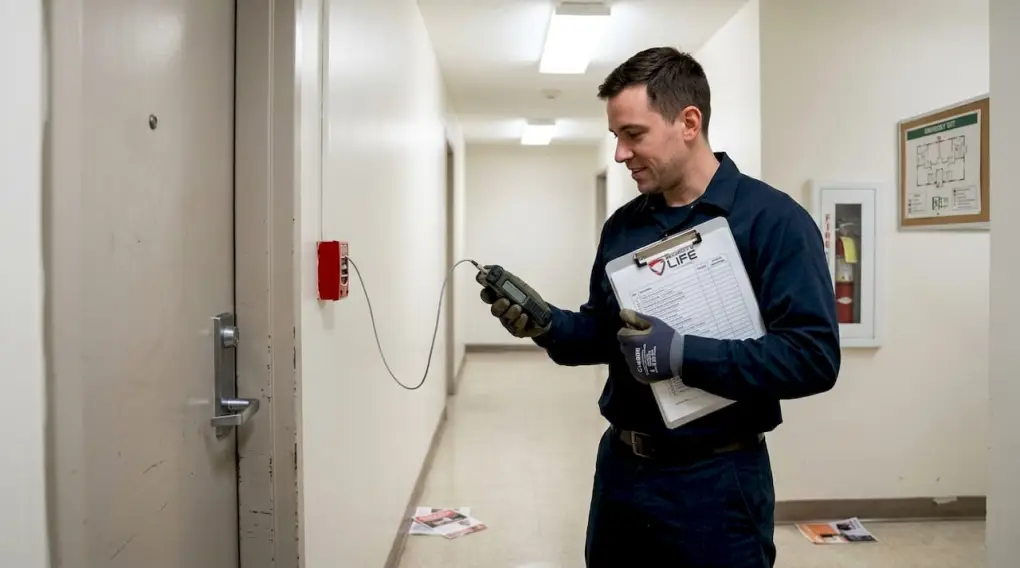
Pro Tip: Switch from paper checklists to a digital platform that logs each entry with a timestamp and user ID. This creates an automatic audit trail and eliminates the risk of lost or altered records.
Comparison: Manual vs. digital fire safety checklists
How you manage your checklist directly impacts both efficiency and audit readiness. Here is a side-by-side comparison to help you decide which approach fits your operation.
| Feature | Manual checklist | Digital checklist |
|---|---|---|
| Cost | Low upfront | Subscription or software cost |
| Audit readiness | Requires physical filing | Instant retrieval, searchable |
| Compliance tracking | Manual review needed | Automated alerts and reports |
| Error risk | High, human transcription | Low, structured fields |
| Historical records | Prone to loss or damage | Cloud-backed, durable |
| Staff training | Minimal | Moderate onboarding |
Digital checklists can reduce audit time by up to 30%, which matters when a fire marshal shows up unannounced.
When manual checklists still make sense:
- Small, single-unit properties with simple code requirements
- Facilities with limited budgets and very low inspection frequency
- Sites where technology access is restricted or unreliable
When digital is the better choice:
- Multi-tenant or multi-building portfolios
- Properties subject to frequent third-party audits
- Any site where staff turnover creates documentation risk
For managers already using fire alarm systems with built-in monitoring, digital checklist tools often integrate directly with your existing platform, making the transition straightforward.
Customizing your checklist for property type and risk
To ensure no gaps, tailor your checklist to the property’s specific risks and code requirements. A one-size approach leaves real hazards unaddressed.
Considerations by property type:
- Multi-tenant residential: Address common area hazards, individual unit detector requirements, shared corridor egress, and tenant notification systems.
- Medical and assisted living: These sites require specialized alarm sensitivity, evacuation procedures for non-ambulatory residents, and stricter suppression standards. Special occupancy types, like assisted living, have unique NFPA standards that go beyond general commercial requirements.
- Schools and educational facilities: High occupancy, frequent drills, and specific egress widths create a more demanding checklist framework.
- High-hazard commercial sites: Flammable liquid storage, industrial equipment, and cooking operations each add specialized suppression and detection requirements.
“NFPA 101, the Life Safety Code, establishes minimum requirements for new and existing buildings to protect occupants from fire, smoke, and related hazards. Requirements vary significantly by occupancy classification.”
If your property falls under medical or assisted living regulations, reviewing medical facility fire standards helps identify compliance gaps specific to your occupancy type. Properties used for worship or assembly, such as churches, have their own considerations covered under church fire safety guidelines.
Involving your local authority having jurisdiction (AHJ) during checklist development is practical. AHJs often clarify ambiguous code language and can confirm whether your checklist meets local amendments before an inspection.
Staying compliant: Recordkeeping, audits, and continuous improvement
With your checklist in place, here is how to document and evolve your safety protocols for real-world compliance.
Records you must keep:
- Test logs: Date, time, result, and technician name for every alarm and suppression test
- Inspection reports: Full vendor reports from annual professional inspections
- Corrective action records: Documentation of every deficiency found and how it was resolved
- Drill records: Participation count, timing, and observations from each evacuation exercise
- Audit results: Any third-party or authority inspection findings and follow-up actions
Routine audits improve compliance and help identify checklist gaps before they become violations.
Sample documentation schedule:
| Task | Frequency | Responsible party |
|---|---|---|
| Alarm function test | Monthly | Facility staff |
| Extinguisher visual check | Monthly | Facility staff |
| Professional alarm inspection | Annual | Licensed vendor |
| Sprinkler system test | Quarterly | Certified contractor |
| Fire drill | Semi-annual minimum | Property manager |
| Full checklist review | Annual | Manager plus vendor |
Scheduling professional alarm repairs as a standing annual appointment prevents the common mistake of deferring service until a malfunction is noticed. Treat your checklist as a living document. Update it whenever codes change, your property is renovated, or an inspection reveals a new risk category.
Why checklists fail: What most property managers overlook
Most fire safety checklist failures do not happen because managers ignored the obvious items. They happen because the checklist became a formality instead of a functional tool.
The most common failure pattern is completion without accountability. A checklist gets signed off, but no one verifies the work or follows up on flagged items. A single uncorrected deficiency, such as a blocked exit corridor or a discharged extinguisher, can cascade into a serious liability if it is present during an incident.
Another overlooked area is tenant and staff training. A tested alarm system is useless if occupants do not know the evacuation procedure. The checklist should include a line item for verifying that training is current, not just that equipment is functional.
Finally, most checklists are built once and never revised. Building use changes. Tenants move in with new equipment. Codes get updated. A checklist that was accurate two years ago may have real gaps today.
Pro Tip: Assign each checklist section to a named individual, not just a job title. Named accountability reduces the chance that a task gets assumed to be someone else’s responsibility.
Fire safety solutions for every property
For property managers who want turnkey fire safety compliance, expert resources are available.
At Security & Life Integrations, we work with property managers, HOA leaders, and business owners to close the gaps that checklists reveal. Whether you need a fully monitored fire alarm system installed from scratch or a professional assessment of your current setup, our team provides UL-certified fire protection across property types. We also specialize in multi-tenant fire protection solutions for residential and commercial portfolios. From initial design to ongoing support, we help you stay compliant, documented, and prepared, without the guesswork.
Frequently asked questions
How often should I test fire alarms in my property?
Fire alarms should be tested monthly and have them professionally inspected at least once a year to meet most fire codes.
What documentation is needed to prove fire safety compliance?
Keep logs of all inspections, maintenance, and fire drills, along with correction reports and audit results. Routine audits improve compliance and reveal gaps before they become violations.
How do I customize a fire safety checklist for a medical facility?
Include standards for vulnerable occupants and extra checks for specialized alarms and suppression systems. Special occupancy types, like assisted living, have unique NFPA requirements that differ from standard commercial properties.
What is the benefit of digital fire safety checklists?
Digital checklists can reduce audit time by up to 30%, and they create automatic, searchable records that are far more reliable during inspections than paper files.
Who should be responsible for fire safety checklist completion?
Assign responsibility to specific named staff members or licensed vendors. Named accountability ensures tasks are completed and follow-up actions are tracked consistently.