

TL;DR:
- Proper security terminology improves communication, system installation, and risk management for property security.
- Frameworks like CPTED and layered security help organize physical design and technical controls effectively.
- Consistent vocabulary reduces false alarms, enhances response times, and minimizes vendor disputes.
Misunderstanding security terminology is more common than most property professionals admit, and it carries real costs. A property manager who confuses “monitored alarm” with “unmonitored alarm” may unknowingly leave tenants exposed. One who misuses “access control” in a vendor contract may end up with the wrong system entirely. This guide breaks down the most important property security terms, explains the frameworks that organize them, and shows you how to apply precise language across staff training, vendor contracts, and tenant communication. Every section is built around practical use, not theory.
Table of Contents
- Understanding key property security terms
- Core frameworks: CPTED and layered security
- Alarm systems, monitoring, and the impact of false alarms
- Physical barriers, access control, and deterrence technologies
- Real-world application: Building a shared security vocabulary
- Why mastering property security language transforms outcomes
- Ready to upgrade your property’s security language and systems?
- Frequently asked questions
Key Takeaways
| Point | Details |
|---|---|
| Define terminology early | Establishing a clear vocabulary upfront prevents confusion and costly miscommunication. |
| CPTED and layering matter | Combining CPTED principles with layered security multiplies your property’s protection. |
| Monitor and verify alarms | Professional monitoring and video verification greatly reduce burglary risk and false alarms. |
| Physical barriers are powerful | Fencing and biometrics substantially cut unauthorized access when used with clear protocols. |
| Standardize language with partners | Using the right terminology in contracts and policies reduces errors and liability. |
Understanding key property security terms
Property security has its own vocabulary. When you use it correctly, vendor conversations go smoother, contracts get clearer, and your team responds faster. When you get it wrong, gaps appear.
Here are the core terms every property manager and business owner should know:
- CPTED (Crime Prevention Through Environmental Design): A framework that uses physical design to reduce crime opportunities. Its four pillars are natural surveillance, access control, territorial reinforcement, and maintenance.
- Intrusion detection: Systems that identify unauthorized entry attempts, including motion sensors, door contacts, and glass-break detectors.
- Access control: Technology that restricts who can enter specific areas, using credentials like key cards, PIN codes, or biometrics.
- Video verification: The use of live or recorded video to confirm whether an alarm event is real before dispatching a response.
- False alarm: An alarm triggered without an actual security event, often caused by user error, equipment faults, or environmental factors.
- Monitored alarm: An alarm system connected to a central monitoring station that responds to alerts 24/7.
- Perimeter security: Measures that protect the outer boundary of a property, including fencing, gates, lighting, and sensors.
- Biometrics: Authentication methods based on physical traits, such as fingerprints, retina scans, or facial recognition.
- Territorial reinforcement: Design or signage that clearly defines private versus public space to discourage unauthorized access.
| Term | What it means | Why it matters |
|---|---|---|
| CPTED | Design-based crime prevention | Shapes property layout decisions |
| Intrusion detection | Unauthorized entry sensing | Core of alarm system specs |
| Access control | Credential-based entry restriction | Vendor contract language |
| Video verification | Visual alarm confirmation | Reduces false alarm response |
| Monitored alarm | 24/7 central station oversight | Defines response expectations |
| Perimeter security | Outer boundary protection | First layer of layered security |
| Biometrics | Physical trait authentication | High-security access points |
Using these terms precisely reduces confusion when selecting vendors and when maintaining systems. Understanding multifamily security risks also helps you match the right term to the right solution. Good key security features start with knowing what each component is actually called.
Pro Tip: Walk through each term with your maintenance and security staff at least once per year. Communication failures between staff and vendors often trace back to a simple vocabulary mismatch.
Core frameworks: CPTED and layered security
With definitions clarified, it is important to see how these terms fit into widely adopted security frameworks and strategies.
CPTED is one of the most widely used frameworks in property security. It organizes physical design decisions around four core principles. Natural surveillance means placing windows, lighting, and open sightlines so that activity is visible. Access control limits entry points. Territorial reinforcement uses design cues to signal ownership. Maintenance keeps the property in good condition to signal active oversight.
“CPTED principles, natural surveillance, access control, territorial reinforcement, and maintenance, form a structured approach to reducing crime through environmental design.”
Layered security builds on CPTED by stacking multiple controls across a property. The outer layer is perimeter security. The middle layer covers building entry points. The inner layer addresses individual spaces. Each layer uses different technology and terminology.
| Feature | CPTED approach | Traditional security |
|---|---|---|
| Focus | Environmental design | Hardware and locks |
| Key terms | Surveillance, reinforcement | Alarm, barrier |
| Entry control | Natural deterrence | Physical locks |
| Maintenance role | Active, visible | Reactive |
| Best for | New builds and retrofits | Existing structures |
Steps to apply CPTED in a commercial or residential setting:
- Audit your property for sightline gaps and poor lighting.
- Identify all entry and exit points and label them as access points.
- Add signage and landscaping that reinforce territorial boundaries.
- Install video entry and access control at primary access points.
- Schedule regular maintenance checks to signal active property management.
- Document all changes using CPTED terminology for vendor and insurance records.
Frameworks like CPTED and layered security do more than organize your thinking. They give you a shared language for contracts, inspections, and vendor briefs. Reviewing CPTED principles for homes can also show how these concepts scale across property types.
Alarm systems, monitoring, and the impact of false alarms
Once you have chosen a framework, the effectiveness comes down to how alarm systems are understood, specified, and managed.
Alarm systems fall into two broad categories. Monitored alarms connect to a central station that responds to alerts at any hour. Unmonitored alarms sound locally but require someone on site to act. The difference matters in vendor contracts and response planning.
Video verification is changing how alarm events are handled. Instead of relying on a sensor trigger alone, a monitoring agent reviews live or recorded footage before dispatching police. This process reduces wasted responses significantly.
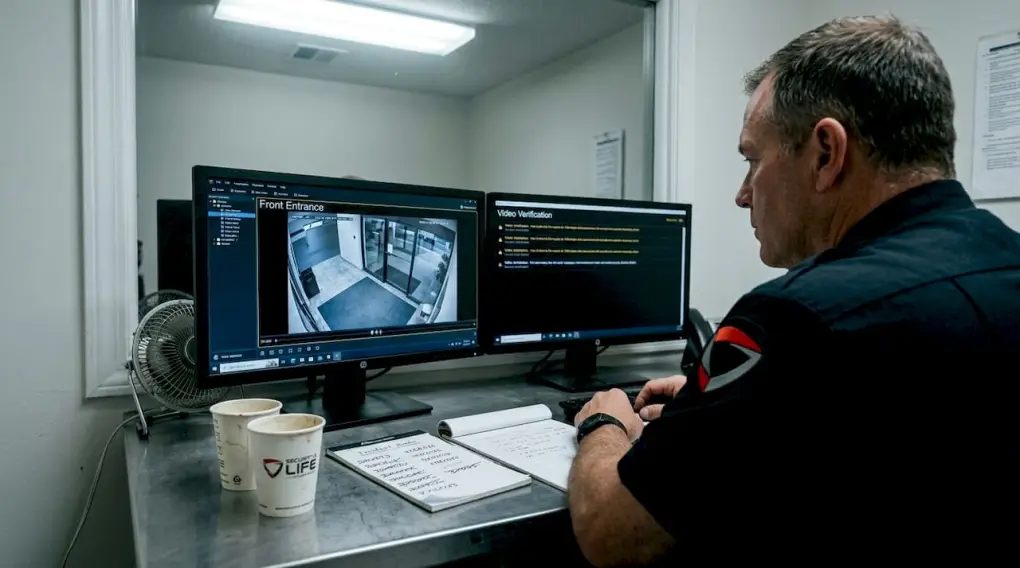
False alarm rates are a major issue: 90 to 99 percent of police alarm calls turn out to be false. Verified response protocols reduce that waste by 60 to 90 percent. At the same time, monitored alarms deter 83 percent of burglars, and properties with alarm systems are 300 percent less likely to be burglarized.
Steps property managers can take to reduce false alarms:
- Train all staff on alarm trigger causes and proper entry procedures.
- Use burglary alarms with adjustable sensitivity settings to reduce environmental triggers.
- Set up video surveillance to support video verification at all monitored entry points.
- Establish a clear alarm response protocol that includes a verification step before calling police.
- Review false alarm logs monthly and adjust sensor placement or sensitivity as needed.
- Coordinate with local law enforcement on verified response policies for your area.
For multi-tenant buildings, alarm management becomes more complex. Multiple users, varied schedules, and shared spaces all increase the chance of false triggers. Clear terminology in your alarm policy helps everyone understand what constitutes a real event. Reviewing expert burglary prevention tips can also inform how you communicate alarm protocols to tenants.
Pro Tip: Proper staff training on alarm triggers and protocols can drastically reduce false alarms and unnecessary police calls. Schedule a drill at least once per quarter.
Physical barriers, access control, and deterrence technologies
Sophisticated monitoring only works when combined with solid physical controls and the right access solutions.
Physical security terminology covers the hardware and systems that form your property’s visible defense. Here are the key terms:
- Perimeter fencing: Barriers that define and protect the outer boundary of a property.
- Access point: Any location where entry or exit is controlled, such as gates, doors, or turnstiles.
- Credentials: Items or data used to verify identity, including key cards, PINs, mobile apps, or biometric data.
- Biometric authentication: Identity verification using physical traits. Common in high-security zones.
- Deterrence technologies: Visible systems like cameras, lighting, and signage designed to discourage unauthorized access before it happens.
Perimeter fencing reduces unauthorized entries by 78 percent. Biometric access control reduces them by 92 percent. These numbers matter when you are writing security specifications or justifying budget requests.
| Technology | Key terminology | Best use case |
|---|---|---|
| Perimeter fencing | Perimeter, barrier | Outdoor property boundaries |
| Key card access | Credentials, access point | Building entrances |
| Biometric readers | Biometric authentication | Server rooms, restricted areas |
| CCTV cameras | Surveillance, deterrence | Common areas, parking lots |
| Motion lighting | Natural surveillance | Pathways, entry points |
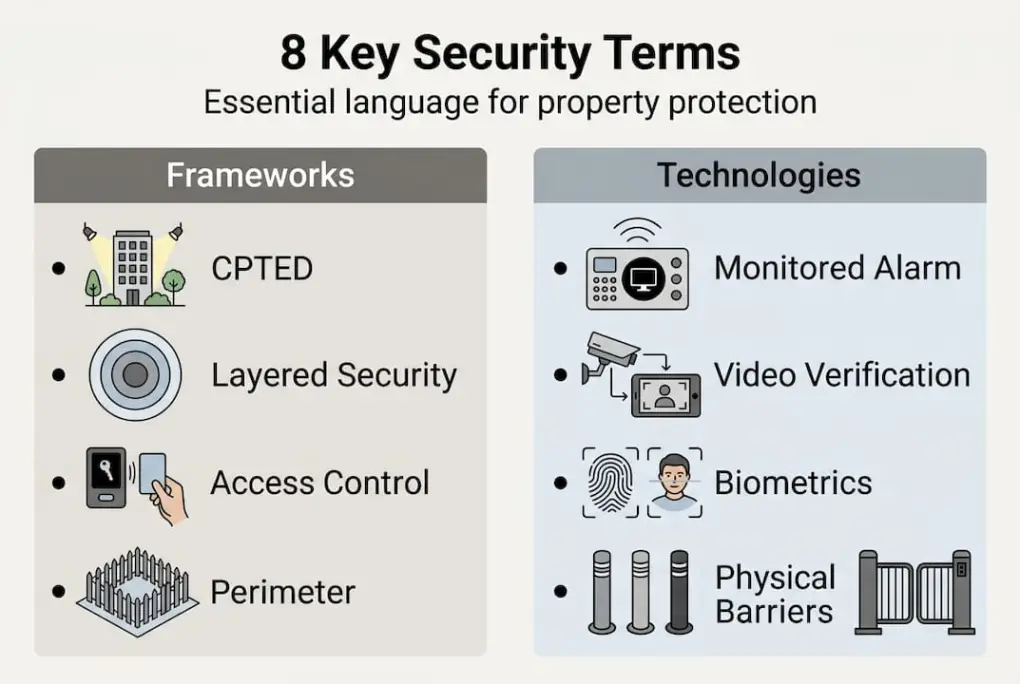
For multi-tenant housing, layering these technologies across access points creates a consistent deterrence effect. Pairing physical barriers with interactive video monitoring adds a verification layer that physical hardware alone cannot provide. Understanding perimeter fencing benefits helps you communicate value to stakeholders when requesting capital improvements.
Speaking the right tech language with vendors leads to better system design and fewer change orders. When you say “biometric authentication at the primary access point,” a vendor knows exactly what to specify. Vague language leads to vague proposals.
Real-world application: Building a shared security vocabulary
With all the fundamentals covered, it is time to make your security language stick operationally.
A shared security vocabulary means that your staff, vendors, and tenants all use the same terms to describe the same things. This reduces errors in emergency response, simplifies vendor negotiations, and builds tenant confidence.
Steps to create and maintain a shared security vocabulary:
- Draft a one-page security glossary using the terms from this guide.
- Include the glossary in onboarding materials for new staff and contractors.
- Add defined terms to vendor contracts, especially for alarm systems, access control, and monitoring.
- Post simplified versions in tenant welcome packets or community portals.
- Review the glossary every 6 to 12 months and update terms as technology changes.
- Use consistent terminology in incident reports so records are accurate and searchable.
Consider how you communicate alarm system benefits to tenants. When you tell a tenant that the building uses a monitored alarm with video verification, you are giving them specific, credible information. Properties with these systems are 300 percent less likely to be burglarized, and monitored systems deter 83 percent of burglars. That is a message worth communicating clearly.
Vendor contracts are another area where terminology pays off. A contract that specifies “video-verified monitored alarm” instead of just “alarm system” sets clear performance expectations and reduces disputes. Staying current on security risks in multifamily properties also helps you update your vocabulary as new threats emerge.
Pro Tip: Review and update your security terminology every 6 to 12 months. New technologies like AI-based video analytics and mobile credentials are changing how terms are defined and used in the field.
Why mastering property security language transforms outcomes
Most property managers focus on hardware upgrades or camera counts when they think about improving security. That is understandable. Hardware is visible and easy to justify in a budget. But the single most overlooked factor in security performance is vocabulary.
When your team does not share a precise understanding of terms like “verified response” or “territorial reinforcement,” small miscommunications compound. A vendor installs the wrong system. A staff member misreports an incident. A tenant misunderstands what the alarm does. Each error is small on its own, but together they create real liability and real cost.
Teams that master security vocabulary have fewer vendor disputes, faster incident responses, and cleaner compliance records. They write better contracts and ask better questions during system reviews. Security technology is evolving fast. AI-assisted video analytics, mobile access credentials, and cloud-based monitoring are all changing what terms mean and how they are used. Ongoing education in security language is not optional. It is part of managing a property responsibly.
Ready to upgrade your property’s security language and systems?
For managers and owners ready to put advanced security terminology into practice, the next move is straightforward: seek expert partnership.
Security & Life Integrations works with property managers and business owners to match the right technology and terminology to each property’s specific needs. Whether you need interactive video monitoring to support verified response, advanced access control systems with biometric or credential-based entry, or professional burglary alarms that meet local compliance standards, the team can help you build a system that is correctly specified from the start. Request a custom security review to align your systems and your vocabulary.
Frequently asked questions
What are the most important security terms every property manager should know?
Key terms include CPTED, intrusion detection, access control, monitored alarms, video verification, perimeter, and biometrics. The four CPTED pillars are natural surveillance, access control, territorial reinforcement, and maintenance.
How does proper use of security terminology help prevent costly mistakes?
Using precise terminology ensures the right systems are installed and understood, reducing miscommunication and risk. Properties with correctly specified monitored alarm systems are 300 percent less likely to be burglarized.
What terminology should I use in vendor contracts for alarm systems?
Include terms like monitored alarm, verified response, false alarm, and access control to describe systems specifically. This precision matters because 90 to 99 percent of police alarm calls are false, and contracts should define how verified response is handled.
What is the impact of video verification versus audio on false alarm response?
Video verification leads to more accurate and efficient responses, reducing false alarms significantly compared to audio. Audio verification carries an 80 to 96 percent false alarm rate, while video confirmation delivers measurably better results.
Recommended
- Top Security Risks in Multifamily Housing: What You Need to Know
- Gated Multi-Tenant Housing Communities: Balancing Security and Convenience
- Property Management Redefined: The Cost Savings of Fire and Life Safety
- Security Solutions for Multi-Tenant Housing | Security & Life Integrations
- Front Door Security Devices That Protect Massachusetts Homes | Sabatalo Contracting
- Garden Cabin Security Features: Protect Your Investment