
TL;DR:
- Different property types require specific alarm solutions to effectively mitigate risks.
- Wired, wireless, and hybrid systems offer trade-offs in reliability, installation, and security features.
- Proper planning and maintenance of alarm systems reduce property loss, liability, and insurance costs.
Alarm systems reduce property loss by 23%, yet many property managers and business owners still treat all alarms as interchangeable. That assumption leads to gaps in coverage, compliance problems, and real financial exposure. The reality is that each property type, from a multifamily housing complex to a commercial office building, has distinct risks that call for specific alarm solutions. This guide breaks down the main types of alarm systems available today, compares their infrastructure options, and gives you a clear framework for making the right choice for your property.
Table of Contents
- Overview of modern alarm types
- Wired vs. wireless vs. hybrid alarms: Features and trade-offs
- Specialty alarms: Beyond the basics
- Smart alarm systems, monitoring, and compliance considerations
- Our perspective: Why choosing the right alarm system pays off far beyond compliance
- Find the right alarm system for your property
- Frequently asked questions
Key Takeaways
| Point | Details |
|---|---|
| Alarm systems reduce risk | A well-chosen alarm setup can lower property losses by 23% and boost insurance savings. |
| Choose infrastructure wisely | Wired, wireless, and hybrid alarms each offer different benefits depending on your property’s needs. |
| Specialty systems add value | Environmental sensors, video monitoring, and two-way communication alarms provide advanced safety features. |
| Smart monitoring matters | Connected alarms with professional monitoring can improve response times and compliance with regulations. |
Overview of modern alarm types
Not all alarms do the same job. Before you evaluate brands or pricing, you need to understand what each category of alarm is actually designed to detect and protect against. Here are the four primary categories you will encounter:
- Intrusion and burglar alarms: These detect unauthorized entry through door and window sensors, motion detectors, and glass-break sensors. They are the most common alarm type for commercial and residential properties. You can explore burglary alarm options to see how these systems are configured for different building layouts.
- Fire alarms: These detect smoke, heat, or flames and trigger evacuation alerts. They are legally required in most commercial and multifamily properties. Regular fire alarm repairs and inspections are essential to keeping these systems code-compliant.
- Environmental alarms: These monitor for carbon monoxide, water leaks, freezing temperatures, and other non-intrusion hazards. They are especially valuable in properties with mechanical rooms, basements, or aging infrastructure.
- Personal safety alarms: Also called panic or duress buttons, these allow staff or residents to silently signal for help during an emergency. They are increasingly standard in multi-tenant offices and maintenance areas.
Each of these alarm categories serves a different threat. A property that only has a burglar alarm is exposed to fire, gas, and environmental risks. A property with only a fire alarm has no intrusion detection at all.
Pro Tip: Combining intrusion, fire, and environmental alarms on a single monitoring platform gives you a unified view of all threats and reduces the number of separate service contracts you need to manage.
One trend worth noting is the shift toward wireless and cellular systems. Wireless and cellular alarms now account for over 58% of the market share. This growth reflects the practical advantages of wireless systems for retrofits and properties where running cable is disruptive or cost-prohibitive.
Wired vs. wireless vs. hybrid alarms: Features and trade-offs
With the main alarm types in mind, it is important to understand how the physical infrastructure affects system performance. The three options are wired, wireless, and hybrid.
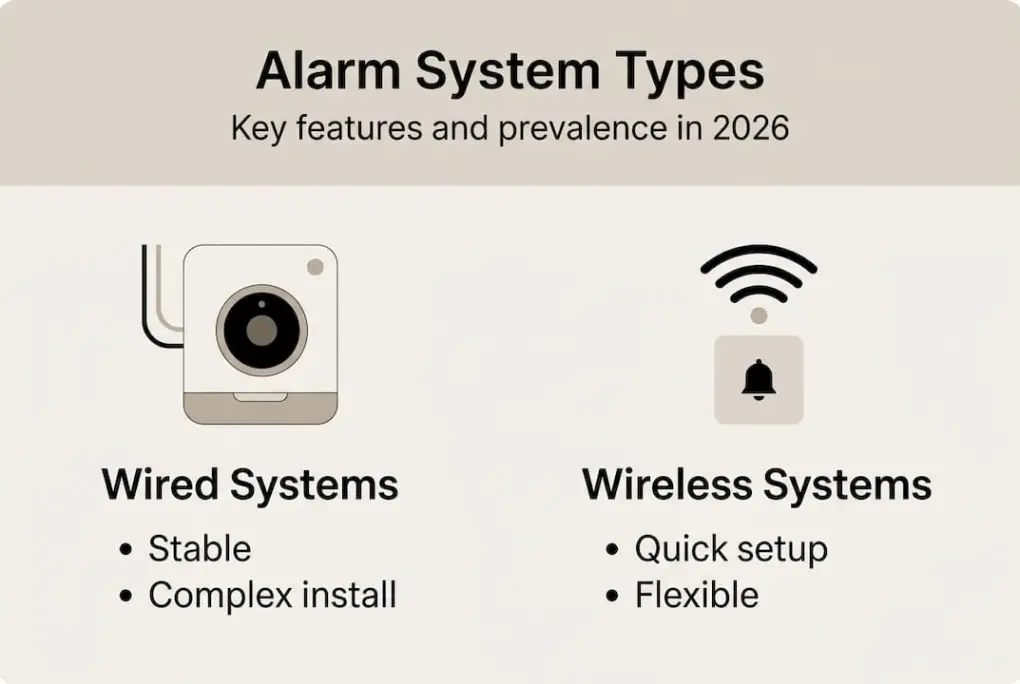
Wired systems use physical cables to connect sensors to the control panel. They are stable, not subject to radio frequency interference, and do not rely on batteries at the sensor level. Wired systems excel in reliability for new construction or high-security installations where the walls are open and cable routing is straightforward.
Wireless systems use radio signals to communicate between sensors and the control panel. Installation is faster and less invasive, making them ideal for occupied buildings or properties with finished walls.

Hybrid systems combine wired and wireless components. They are the most flexible option and work well for properties that are expanding or upgrading in phases.
Here is a side-by-side comparison:
| Feature | Wired | Wireless | Hybrid |
|---|---|---|---|
| Reliability | Very high | High | High |
| Installation disruption | High | Low | Medium |
| Battery maintenance | None | Required | Partial |
| Anti-jamming risk | None | Present | Partial |
| Best for | New builds | Retrofits | Mixed environments |
Choosing the right infrastructure depends on your specific situation. Here are the main scenarios:
- New construction: Choose wired for maximum reliability and no ongoing battery costs.
- Occupied retrofit: Choose wireless to avoid disruption to tenants and operations.
- Multi-building or phased upgrade: Choose hybrid to integrate existing wired zones with new wireless sensors.
- High-security environments: Choose wired or hybrid with anti-jamming detection enabled.
For multi-tenant housing solutions, hybrid systems are often the practical choice because buildings are already occupied and full rewiring is not feasible. You should also review door prop alarm standards when planning intrusion coverage for shared entry points.
Pro Tip: For wireless systems, schedule battery checks twice a year and confirm your control panel has radio frequency jamming detection enabled. A jammed sensor that goes undetected is a serious vulnerability.
For a detailed technical breakdown of wired and wireless security trade-offs, reviewing independent comparisons alongside vendor specs will give you a more complete picture.
Specialty alarms: Beyond the basics
Once the core alarm infrastructure is in place, specialty alarms add layers of protection that standard systems cannot provide. The alarm monitoring market is growing rapidly due to new technology adoption, and these specialty categories are a big part of that growth.
Here are the specialty alarm types most relevant to property managers:
| Alarm type | Key features | Best use case |
|---|---|---|
| Carbon monoxide detector | Continuous gas monitoring, audible alert | Buildings with gas appliances or parking garages |
| Flood and freeze sensor | Water presence or temperature drop detection | Basements, mechanical rooms, server rooms |
| Video-verified alarm | Camera confirms trigger before dispatch | Reducing false alarm fees, high-value areas |
| Two-way communication | Live audio link to monitoring center | Panic situations, elevator entrapment |
| Smoke and heat detector | Dual-sensor fire detection | Commercial kitchens, storage areas |
Video-verified alarms deserve special attention. When a sensor triggers, a monitoring agent reviews live or recorded footage before dispatching police. This dramatically cuts false alarm fees, which can add up quickly for busy commercial properties. You can learn more about video monitoring integration and how it connects with alarm systems.
For properties with maintenance staff or shared office spaces, multi-tenant panic alarms provide a critical layer of personal safety that standard intrusion alarms do not cover.
Key add-on features that matter for property managers include:
- Mobile alerts and remote arm or disarm capability
- Integration with access control systems
- Automated reporting for compliance documentation
- Redundant communication paths (cellular backup if internet fails)
Smart alarm systems, monitoring, and compliance considerations
Modern alarm systems are not just about detection. They are about response time, liability management, and meeting the regulatory and insurance requirements that apply to your property type.
“Alarm monitoring reduces property loss significantly and meets compliance standards,” according to the Alarm Monitoring Market Report.
Smart and connected monitoring platforms send instant alerts to a central station and directly to your phone. Faster response means less damage, lower liability, and documented proof of due diligence for insurers and regulators.
Here is a step-by-step process for selecting, installing, and maintaining a modern alarm system:
- Conduct a property risk assessment: Identify all entry points, hazard zones, and occupancy patterns before choosing any equipment.
- Match alarm types to identified risks: Do not buy a generic package. Select intrusion, fire, environmental, and specialty alarms based on your actual risk profile.
- Choose a monitoring plan: Decide between self-monitoring and professional 24/7 central station monitoring. Most insurers and local codes require the latter.
- Verify compliance requirements: Check local fire codes, insurance policy conditions, and any applicable standards for your property type.
- Schedule regular maintenance: Test all sensors quarterly, replace wireless batteries every one to two years, and document every inspection.
- Review anti-jamming settings: For wireless systems, confirm the control panel actively monitors for signal interference.
For ongoing fire alarm upkeep, a documented maintenance schedule is often required to maintain your UL certification and satisfy insurance audits. Properties with multiple units should also review multi-tenant fire protection requirements specific to their jurisdiction.
Compliance is not a one-time event. It is an ongoing process that requires scheduled testing, documentation, and periodic system upgrades as codes evolve.
Our perspective: Why choosing the right alarm system pays off far beyond compliance
Here is something that does not get said enough: compliance is a floor, not a ceiling. Many property managers install the minimum required alarm coverage, check the box, and move on. Then a water leak sensor that was never installed causes $40,000 in damage to a mechanical room. Or false alarms from an uncalibrated smoke detector generate repeated fines and erode tenant trust.
The real cost of a poorly chosen alarm system is not the equipment. It is the downtime, the liability exposure, and the tenant turnover that follows a preventable incident. We have seen properties where reducing property management costs came directly from investing in the right alarm mix upfront, not from cutting corners on coverage.
The extra step that pays off is a proper needs analysis before any purchase. Map your risks, talk to a specialist, and build a system that fits your property. That investment in planning almost always costs less than a single incident that the right alarm would have prevented.
Pro Tip: Before committing to any alarm system, request a written needs analysis from your provider. A reliable partner will document your risk profile and justify every component they recommend.
Find the right alarm system for your property
Selecting the right alarm system is a decision that affects your property’s safety, your compliance standing, and your bottom line. Security & Life Integrations works with property managers and business owners to design alarm solutions that fit the actual risks of each property.

Whether you need fire alarm systems for a multifamily building, burglary alarms for a commercial space, or video monitoring solutions that integrate with your existing setup, we provide tailored recommendations backed by 24/7 support. Contact us to schedule a consultation and get a system designed around your property’s specific needs.
Frequently asked questions
Which type of alarm system is best for a multi-tenant building?
A hybrid system with monitored fire and intrusion alarms, plus integrated access control, usually offers the best balance of protection and flexibility for multi-tenant properties. Hybrid alarms suit complex and retrofitted environments where full rewiring is not practical.
Do alarm systems really lower property insurance premiums?
Yes, many insurers offer premium reductions for properties with 24/7 professionally monitored alarm systems, as they reduce average property loss by 23%.
How often should wireless alarm system batteries be replaced?
Most wireless alarm batteries should be checked twice yearly and replaced according to manufacturer recommendations, usually every one to two years. Regular battery schedules are crucial for maintaining continuous wireless alarm coverage.
Are anti-jamming features required for wireless alarms?
Yes, best practices and many local codes require anti-jamming detection for wireless systems to ensure continuous coverage. Anti-jamming is mandated under PD 6662 and is considered a standard requirement for compliant wireless installations.
What is the expected growth of the alarm system market?
The alarm monitoring market is expected to nearly double, with market size reaching $121.1 billion by 2035, up from $65.4 billion in 2025.
Recommended
- Door Prop Alarms for Multitenant Housing | Security & Life Integrations Inc
- Panic Buttons and Burglary Alarms for Multi-Tenant Housing | Security & Life Integrations Inc
- Property Management Redefined: The Cost Savings of Fire and Life Safety
- Burglar & Panic Alarms for Schools | Security & Life Integrations
- 7 Essential Fire Alarm Maintenance Tips for Property Managers