

TL;DR:
- Fire safety involves prevention, compliance, and preparedness measures that save lives and protect property. Ensuring functioning smoke alarms, fire doors, and regular drills reduces risk, legal liability, and financial consequences of fires. Building a safety culture and proactive maintenance are essential to prevent reactive failures and system neglect.
Most people think fire safety is someone else’s problem until it isn’t. Working smoke alarms cut the risk of dying in a home fire by roughly 50%, yet millions of buildings still operate without functioning detection systems. Why fire safety matters goes far beyond placing a detector on a ceiling. It covers prevention, compliance, preparedness, and the real financial and legal consequences of getting it wrong. This guide covers all of those areas so you can make informed decisions for your home, your tenants, or your organization.
Table of Contents
- Key Takeaways
- Why fire safety matters in homes and workplaces
- Core components of effective fire safety measures
- Fire safety compliance and legal responsibility
- Building a culture of fire safety awareness
- My perspective on where fire safety goes wrong
- How Security & Life Integrations can help
- FAQ
Key Takeaways
| Point | Details |
|---|---|
| Smoke alarms save lives | Working alarms reduce home fire death risk by 50%; placement inside every bedroom is required by NFPA 72. |
| Compliance carries real costs | OSHA fire safety violations can reach $156,259 per incident, making non-compliance far more expensive than prevention. |
| Escape plans need practice | Only 47% of households with escape plans have actually practiced them, which defeats the purpose entirely. |
| Legal duty cannot be transferred | Building owners and managers remain legally responsible for fire safety even when tasks are outsourced to contractors. |
| Culture matters as much as equipment | Over 25% of decision-makers say fire safety is not taken seriously enough inside their own organizations. |
Why fire safety matters in homes and workplaces
The core reason fire safety matters is simple: fire moves faster than most people expect, and unpreparedness turns a manageable situation into a fatal one.
Three out of five home fire deaths occur in buildings with no working alarms. That single fact explains more about the importance of fire safety than most training courses ever do. In workplace settings, the numbers are equally serious. Workplace fires cause roughly 38,000 industrial fires per year in the United States, resulting in approximately $1.2 billion in property damage annually.
The benefits of fire safety extend well beyond preventing death and injury. They include:
- Life protection. Early detection gives occupants the seconds and minutes needed to exit safely.
- Property preservation. Fire suppression systems and early warnings limit structural damage and loss of contents.
- Financial risk reduction. OSHA penalties for fire safety violations can reach $156,259 per incident, not counting civil liability or business interruption costs.
- Legal standing. Demonstrating compliance with NFPA codes, OSHA standards, and local fire codes protects building owners from criminal and civil liability.
- Business continuity. A fire that shuts down operations for weeks or months can end a business entirely. Prevention keeps operations running.
Understanding how fire alarm systems work is a practical starting point for any property owner or manager evaluating their current level of protection. The relationship between detection speed, alarm type, and occupant response time is direct. Every minute of delay increases exposure to toxic gases, structural collapse risk, and blocked exit routes.
Core components of effective fire safety measures
Fire safety is not a single product or policy. It is a set of interconnected systems and behaviors that work together. When one element fails, the others must compensate.
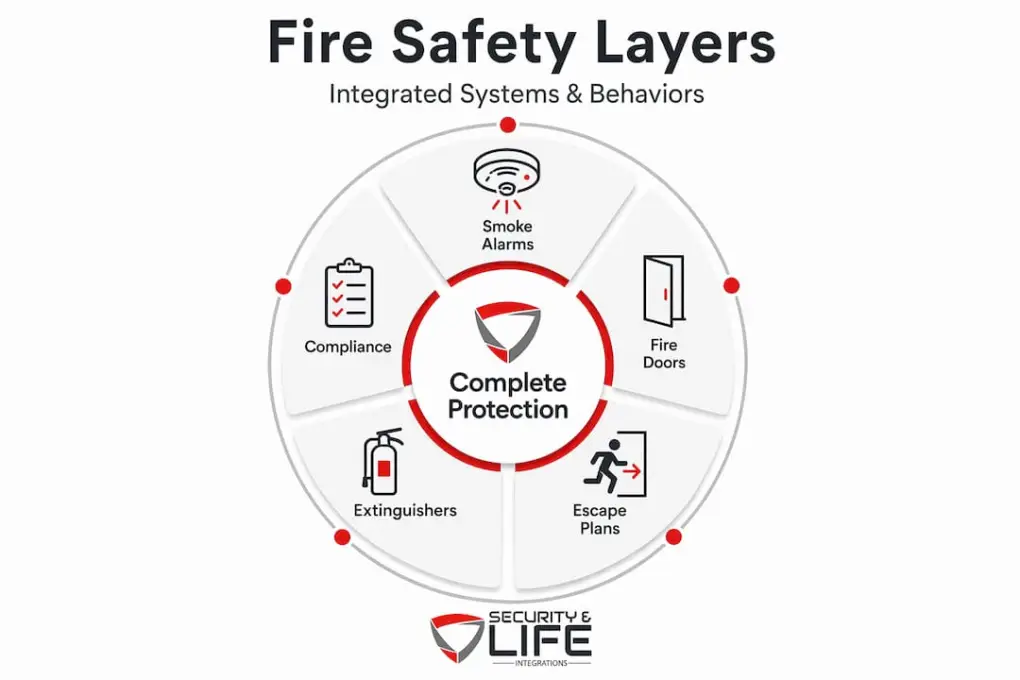
Smoke alarm types and placement
Not all smoke alarms perform the same way. Photoelectric alarms respond faster to smoldering fires and produce fewer nuisance alarms compared to ionization-only models. For most settings, combination alarms that use both technologies offer the most reliable coverage.
Placement matters as much as alarm type. NFPA 72 requires alarms inside every bedroom because a closed door reduces alarm audibility by 20 to 25 decibels. A hallway alarm outside a closed bedroom door may not wake a sleeping occupant in time. This is a detail many building owners overlook until it becomes a compliance finding or a tragedy.
Pro Tip: Test smoke alarms monthly, replace batteries annually, and replace the entire unit every 10 years. Alarms degrade over time, and an outdated unit may fail to detect smoke even if it appears functional.
Fire doors and passive protection
Fire doors are a critical but frequently neglected layer of protection. Misaligned or propped-open fire doors compromise compartmentation, the strategy of containing a fire within a specific zone to slow its spread. Regular inspection by a trained professional catches alignment issues, damaged seals, and improper hardware before they become a liability.
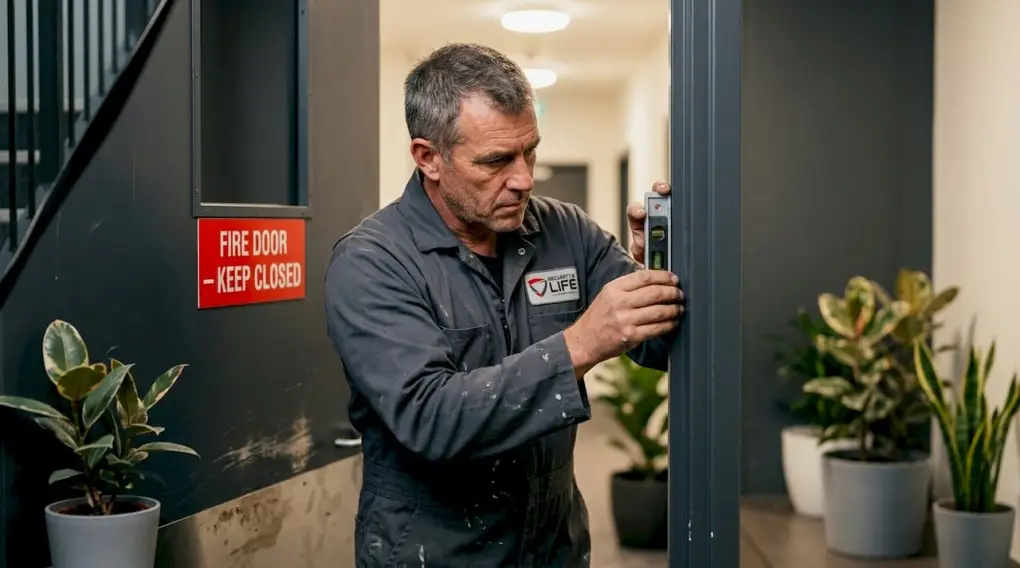
The table below shows a quick comparison of the two main categories of fire protection:
| Protection type | Examples | Primary function |
|---|---|---|
| Active protection | Smoke alarms, sprinklers, fire extinguishers | Detect and suppress fire events |
| Passive protection | Fire doors, fire-rated walls, compartmentation | Contain and slow the spread of fire |
Both categories are required for a complete system. Active protection detects and responds. Passive protection buys time.
Escape plans and fire extinguisher realities
Occupants have roughly 2 minutes to exit safely after a smoke alarm sounds before conditions become unsurvivable. That window is shorter than most people believe, which is why escape plan practice is non-negotiable, not optional. Yet only 47% of households with an escape plan have ever practiced it.
Fire extinguishers serve a specific and limited purpose. They are designed to handle small, contained fires in their earliest stage. They are not a substitute for evacuation. Every building occupant should know the PASS method: Pull the pin, Aim at the base, Squeeze the handle, Sweep side to side. But the first action when a fire grows beyond a wastebasket size is to evacuate and call emergency services.
Fire safety compliance and legal responsibility
Why fire safety compliance matters is not an abstract question. It has direct legal and financial answers that affect every building owner and property manager.
Here are the core compliance obligations and their implications:
- OSHA fire safety standards cover all workplaces in the United States and require documented emergency action plans, accessible exit routes, working fire detection equipment, and employee training. Violations are assessed per incident and per day of non-compliance.
- NFPA codes set the technical standards for fire alarm systems, sprinkler systems, and life safety equipment. NFPA 101 (Life Safety Code) and NFPA 72 (National Fire Alarm and Signaling Code) are the two most referenced standards in commercial and residential settings.
- Local fire codes vary by jurisdiction and may exceed federal minimums. Property managers need to verify requirements with their local authority having jurisdiction (AHJ) rather than assuming federal standards are sufficient.
- The Responsible Person designation. Under frameworks like the Regulatory Reform (Fire Safety) Order 2005 in the UK, and analogous standards in many US jurisdictions, legal responsibility cannot be delegated from the person accountable for a building. Hiring a contractor to manage fire safety does not transfer legal liability away from the building owner or designated manager.
- Record-keeping requirements. Inspections, maintenance records, training logs, and fire risk assessments must be documented and retained. Absence of records is treated as absence of compliance.
Non-compliance is not a low-probability risk. Fire marshals conduct routine inspections, and insurance carriers increasingly require documented compliance as a condition of coverage. The financial consequences of non-compliance, combining fines, civil liability, increased premiums, and business disruption, consistently exceed the cost of getting systems in place. Security & Life Integrations provides a detailed fire safety checklist that property managers can use to assess their current standing.
Building a culture of fire safety awareness
Having the right equipment and meeting compliance requirements is a baseline. Sustaining safety over time requires a culture where fire preparedness is a routine part of operations, not an annual checkbox.
89% of decision-makers say fire safety is a strategic priority, but more than 25% believe it is not taken seriously enough within their own organizations. That gap between stated priority and actual behavior is where most fire safety failures originate.
Building that culture requires specific, consistent actions:
- Conduct fire drills on a regular schedule. Why we need fire drills is straightforward: muscle memory built in practice overrides panic during an actual event. Annual drills are a minimum. Quarterly drills for high-occupancy buildings are more effective.
- Integrate fire safety education into onboarding. New employees and new tenants should receive fire safety orientation as a standard part of their first days. This sets expectations and transfers responsibility appropriately.
- Address complacency directly. People stop noticing things they see every day. Rotate the person responsible for pre-shift safety checks. Vary drill times and scenarios to prevent predictable, low-engagement responses.
- Maintain equipment on a documented schedule. Alarms, extinguishers, suppression systems, and fire doors all require periodic inspection and maintenance. Reactive maintenance after a failure is not a safety strategy.
Pro Tip: Fire safety awareness is most effective when it is connected to real consequences. Share incident reports, near-miss events, or case studies from your industry during training sessions. Abstract rules are easier to ignore than real outcomes.
Framing fire safety as infrastructure rather than an added cost changes how organizations prioritize and fund it. Infrastructure gets maintained. Optional expenses get deferred.
My perspective on where fire safety goes wrong
In my experience working with property managers and building owners across residential and commercial settings, the most common failure is not ignorance. It is the assumption that existing systems are sufficient because nothing has gone wrong yet.
I have seen buildings with smoke alarms that had not been tested in three years. I have seen fire doors propped open permanently because closing them was inconvenient. I have seen compliance binders with outdated inspection records that no one had reviewed since the last audit. In every case, the people responsible believed they were doing enough.
What I have found is that fire safety investment is almost always reactive. A near-miss, a failed inspection, or a tenant complaint triggers action. The property that acts before something happens is the exception, not the rule. And the cost difference between proactive maintenance and emergency remediation is not small.
The widespread undervaluation of fire safety despite clear evidence of its benefits is a systemic problem. It exists because the cost of prevention shows up as a line item on a budget, while the cost of inaction only shows up after a loss. That accounting is backwards, and most property managers know it intellectually but do not act on it consistently.
My recommendation is straightforward. Schedule a full audit of your current systems, document what you find, and address deficiencies in order of life safety risk. Do not wait for an inspection or an incident to create the urgency that should already exist.
— Zachary
How Security & Life Integrations can help
Security & Life Integrations provides UL-certified fire protection systems for residential, commercial, multi-tenant housing, and medical care facilities. Whether you need a new fire alarm system installed from the ground up or support bringing an existing system into compliance, the team delivers solutions tailored to your specific property type and regulatory requirements.

For property managers overseeing multi-unit buildings, Security & Life Integrations offers specialized fire protection for multi-tenant housing that accounts for the complexity of shared spaces, varied occupancy, and layered compliance obligations. The company also offers 24/7 monitoring support and ongoing maintenance programs to keep systems functioning correctly between formal inspections. Reach out to Security & Life Integrations to schedule a compliance consultation and identify the right protection plan for your property.
FAQ
What percentage of home fire deaths involve missing or broken alarms?
Three out of five home fire deaths occur in homes with no smoke alarms or alarms that were not working. This makes functioning alarm systems the single most impactful fire safety measure available.
How long do occupants have to escape after a smoke alarm sounds?
Occupants typically have about 2 minutes to exit safely after an alarm sounds before conditions become unsurvivable. This is why practiced escape plans matter more than improvised responses.
What are the financial penalties for fire safety violations?
OSHA penalties for fire safety violations can reach $156,259 per incident. Civil liability, increased insurance premiums, and business interruption costs add significantly to that total.
Can a building owner delegate fire safety legal responsibility?
No. Legal responsibility for fire safety remains with the designated responsible person even when specific tasks are contracted out. Outsourcing tasks does not transfer accountability.
What is the difference between active and passive fire protection?
Active protection includes smoke alarms, sprinklers, and extinguishers that detect and suppress fires. Passive protection includes fire doors and fire-rated construction that contain fires and slow their spread. Both are required for full fire safety compliance.