

TL;DR:
- Proper planning and documentation are essential to ensure CCTV systems are compliant and effective.
- Lighting conditions significantly impact camera footage quality, especially at night.
- Well-designed systems focus on context, privacy, and legal considerations rather than just camera quantity.
A property manager reviews footage after a late-night incident, only to find the camera angle cuts off at the wrong point, the recording quality is too poor to identify anyone, and there is no documented policy for how long the footage was stored. This scenario plays out more often than most operators expect. Poor CCTV planning does not just create security gaps. It creates legal exposure. This guide walks you through every stage of a compliant, effective installation, from pre-planning and tool selection to step-by-step setup, verification, and the most common mistakes that compromise both footage quality and your legal standing.
Table of Contents
- Pre-installation essentials: Planning for compliance and security
- Tools and requirements for CCTV installation
- Step-by-step guide: Installing your CCTV system
- Troubleshooting and mistakes to avoid in CCTV installation
- Our perspective: Why compliance and context matter more than camera count
- Integrate smarter CCTV solutions for your property
- Frequently asked questions
Key Takeaways
| Point | Details |
|---|---|
| Plan with compliance | Assess privacy risks and document your CCTV purpose and retention before installation. |
| Lighting matters | Proper ambient and site lighting is critical for camera performance, especially at night. |
| Avoid common mistakes | Ensure proper placement, signage, and retention to prevent compliance failures. |
| Verify effectiveness | Test both day and night operation, adjusting based on local risk and real outcomes. |
| Professional integration | Tailored CCTV and security solutions can maximize safety and compliance for all property types. |
Pre-installation essentials: Planning for compliance and security
Before a single cable is run or bracket is mounted, you need a clear plan. Skipping this stage is the single most common reason CCTV systems underperform or create liability.
Start with your goals. Are you trying to deter crime at entry points? Monitor loading docks or parking areas? Support access control with video verification? Each goal changes where cameras go, what resolution you need, and how long footage should be stored. A system built around the wrong goal will not deliver results, no matter how many cameras you install.
Assess privacy-sensitive areas carefully. Restrooms, changing areas, and private offices are off-limits without strict legal justification. Even in common areas, you need to think about what your cameras will capture from neighboring properties or public spaces. As ICO guidance notes, CCTV system design should minimize privacy impact, avoid filming private areas, and include clear signage and documented retention policies. This is not optional guidance. It is the framework your system needs to be built around.
Document everything before installation day. This includes your security purposes, which areas will be monitored and why, how long footage will be retained, who has access to it, and how deletion will be handled. You also need site diagrams, lighting maps showing dark zones after hours, and any local or state compliance requirements that apply to your property type.
For multi-tenant properties specifically, planning becomes more layered. Review multi-tenant camera planning considerations before finalizing placement decisions, since tenant privacy expectations and local housing rules add additional constraints.
Comparison: Reactive vs. planned CCTV installation
| Factor | Reactive installation | Planned installation |
|---|---|---|
| Camera placement | Ad hoc, coverage gaps | Based on site diagrams and goals |
| Privacy compliance | Often overlooked | Documented and verified |
| Footage usability | Inconsistent quality | Optimized for lighting and angle |
| Legal standing | Vulnerable | Defensible |
| Signage | Missing or misplaced | Strategically placed |
Key pre-installation checklist:
- Define security objectives in writing
- Map all coverage zones and exclusion zones
- Identify lighting conditions at all hours
- Draft retention and deletion policy
- Prepare compliant signage for all monitored areas
- Review local regulations and lease agreements
- Confirm network and power infrastructure capacity
Pro Tip: If your property has vehicle entry points, review license plate camera options during planning. Standard cameras often lack the resolution to capture plate numbers clearly, especially in low-light conditions or at vehicle speed.
Tools and requirements for CCTV installation
With a solid plan in place, you need the right equipment and infrastructure. Choosing the wrong tools at this stage wastes money and forces costly rework later.
Camera types to know:
- Fixed cameras cover a set field of view. They are reliable, lower cost, and suited for defined zones like entryways or hallways.
- PTZ (pan-tilt-zoom) cameras allow remote movement and zoom. They are useful for large open areas like parking lots where an operator needs flexible coverage.
- AI-enabled cameras can detect motion patterns, identify objects, and trigger alerts automatically. Learn how AI-enhanced CCTV is changing how properties manage surveillance in real time.
Storage and recording options:
- NVR (Network Video Recorder) systems store footage on a local server connected via IP network. They support high-resolution cameras and are standard for commercial properties.
- Cloud storage offers off-site backup and remote access but requires reliable internet bandwidth and ongoing subscription costs.
- Edge storage records directly onto the camera’s memory card. It works as a backup but is not suitable as a primary storage method for high-stakes environments.
Infrastructure requirements:
- Power supply: Confirm whether cameras will use PoE (Power over Ethernet), which simplifies wiring, or require separate power runs.
- Network capacity: Calculate bandwidth demand based on camera count and resolution. A 4K camera can use significantly more bandwidth than a 1080p unit.
- Mounts and weatherproofing: Outdoor cameras need IP65 or higher ratings. Bracket placement must account for vibration, wind, and thermal expansion.
Why lighting matters more than most operators expect. Research on Detroit’s Green Light Project shows that CCTV effectiveness varies by context and is directly influenced by supporting infrastructure like lighting. A high-resolution camera pointed at a poorly lit area will produce footage that is no more useful than a low-resolution camera in the same spot. Lighting is not just a background condition. It is a core part of your system design.
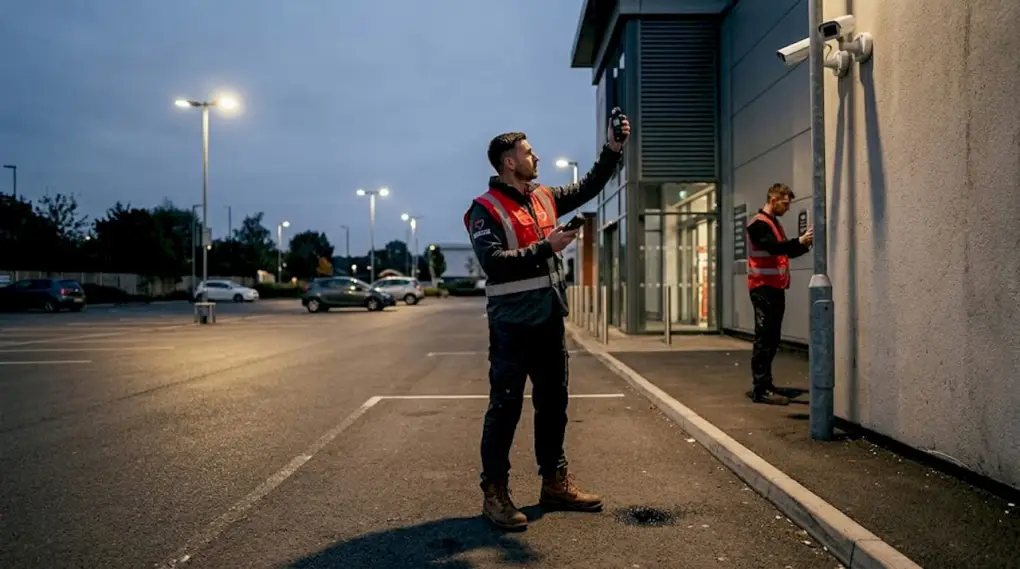
This is especially relevant for institutional properties. CCTV for religious buildings, for example, often involves large parking areas and exterior spaces that are minimally lit outside of service hours, making lighting integration essential to nighttime performance.
Equipment summary table:
| Component | Purpose | Key specification |
|---|---|---|
| Fixed camera | Defined zone coverage | Resolution, field of view |
| PTZ camera | Flexible large-area monitoring | Pan/tilt range, zoom ratio |
| NVR system | Local footage storage and management | Storage capacity, channel count |
| PoE switch | Simplified power and network | Port count, total wattage |
| Weatherproof housing | Outdoor camera protection | IP rating |
| Signage | Compliance and deterrence | Visibility, placement |
Step-by-step guide: Installing your CCTV system
Follow this sequence carefully. Each step builds on the previous one, and skipping steps, especially verification, is where most installations develop problems.
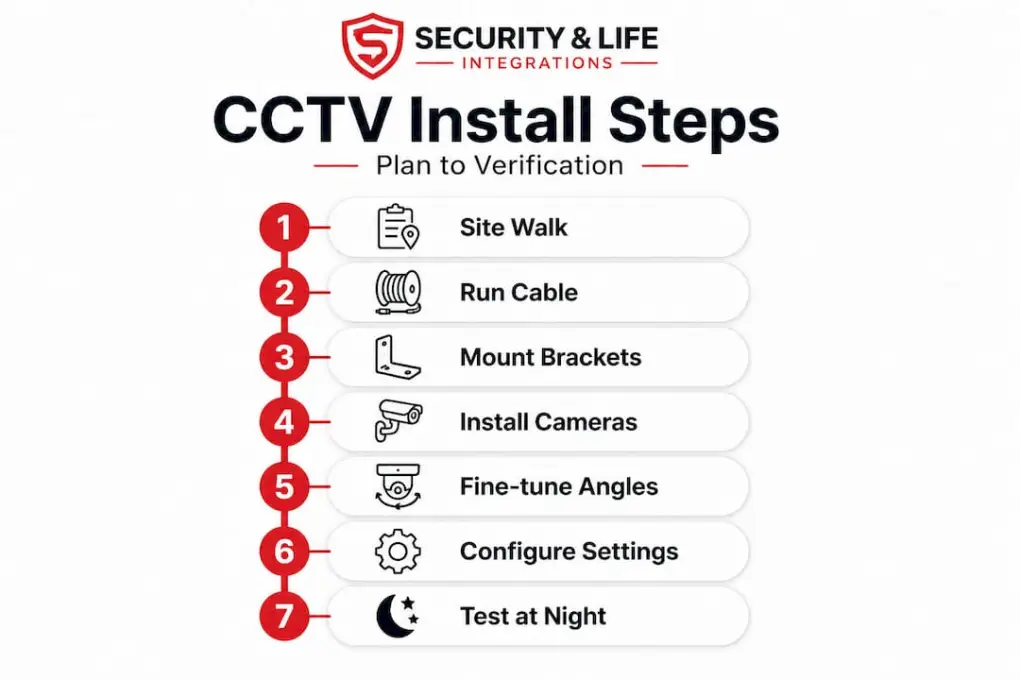
1. Prepare the site. Walk every camera location with your site diagram in hand. Check for obstructions, confirm power access points, and identify cable routing paths. Mark any areas where drilling or conduit work is required. Test all electrical circuits before connecting any equipment.
2. Run cables before mounting cameras. This is the correct sequence. Running cable after mounting creates rework. Use conduit for all exposed exterior runs. Label each cable at both ends before connecting anything.
3. Mount camera brackets and housings. Use appropriate anchors for the wall or ceiling material. Confirm each bracket is level and aimed at the intended coverage zone before tightening fully. Leave adjustment room in the mount so you can fine-tune angles after power-up.
4. Install cameras and connect to the network. Connect each camera to its labeled cable. Power up one at a time and confirm the NVR or recording system detects each unit. This lets you catch connection issues before moving on.
5. Adjust camera angles for maximum coverage. Use the live feed on your NVR display to fine-tune each camera. Ensure coverage zones overlap at entry points so there are no blind spots. Avoid pointing cameras directly at private areas or neighboring properties. This step directly supports your obligation to avoid filming private spaces, as ICO guidance requires that installation avoids private spaces unless justified.
6. Configure storage, access controls, and privacy settings. Set your retention period to match your documented policy. Restrict system access to authorized personnel only, using role-based permissions where your NVR supports it. Enable any built-in privacy masking for areas that are visible in the camera frame but should not be recorded.
7. Test for both daytime and nighttime performance. Daytime testing is straightforward, but nighttime testing is where most systems reveal problems. Research confirms that nighttime performance degrades significantly if lighting is not co-designed with the camera system. Walk the site after dark and verify each camera produces usable footage. Adjust IR (infrared) settings or add supplemental lighting where needed.
8. Install and confirm signage placement. Signage must be visible before a person enters the monitored zone, not after. Check each sign’s visibility from the approach angle, not just from within the monitored area.
9. Document the completed installation. Record camera locations, coverage zones, equipment model numbers, firmware versions, storage configuration, and access credentials in a secure document. This record supports future audits, insurance claims, and compliance reviews.
For properties with specialized environments, the church CCTV installation guide provides additional context on handling mixed-use spaces, and medical facility camera setup covers the stricter requirements around patient-accessible areas.
Pro Tip: Schedule your nighttime test on a night with no scheduled events or foot traffic. You want to see the camera’s baseline performance without variables, not its performance under the best possible conditions.
Troubleshooting and mistakes to avoid in CCTV installation
Even well-planned installations run into problems. Knowing the most common errors helps you catch them before they become compliance issues or footage failures.
Lighting gaps are the most overlooked problem. Many property managers test cameras during the day and assume nighttime performance will be similar. It will not be. Infrared range varies significantly by model, and ambient light sources, including streetlights and signage, affect footage quality in ways that are hard to predict without testing. Review video surveillance best practices to understand how lighting interacts with camera performance before assuming your system is ready.
Missing or incomplete retention documentation is a compliance risk. Storing footage indefinitely, or deleting it without a documented schedule, both create legal exposure. Your policy needs to specify exact retention periods, the deletion method, and who is responsible for confirming deletion has occurred.
Incorrect placement that captures private zones. This happens when installers focus on maximizing coverage without checking what neighboring or interior spaces appear in the frame. Run a full review of each camera’s live feed from a compliance perspective, not just a security one.
Skipping final verification. A completed installation is not a verified installation. Final verification means testing every camera, confirming storage is writing correctly, validating access controls are working, and physically checking that signage is in place and visible.
Calibrating your system to local crime patterns. Research on CCTV in low-crime settings shows that its impact can be statistically insignificant when the camera placement does not align with actual local risks. Your final checks should focus on locally relevant threats and compliance accuracy, not just installation completion. Additional context on how surveillance cameras reduce crime is worth reviewing when setting your expectations for what a well-placed system can realistically deliver.
Common mistakes checklist:
- Testing only in daylight
- No written retention and deletion policy
- Cameras angled into private or off-property zones
- Signage missing from approach paths
- Access to footage not restricted by role
- No documentation of camera placement or system configuration
- Failure to match camera placement to local crime risk
Pro Tip: Conduct a quarterly compliance review, not just an annual one. Camera positions can shift slightly after weather events or maintenance work, and access credentials change as staff turns over. A brief quarterly check catches these issues before they become problems.
Our perspective: Why compliance and context matter more than camera count
The most common assumption in CCTV planning is that more cameras equal better security. In practice, this is not supported by the evidence, and it leads property managers to over-invest in hardware while under-investing in the factors that actually determine whether a system works.
Compliance is not just a legal requirement. It is a design discipline. When you document your retention policies, restrict access to footage, place signage correctly, and design around privacy exclusions, you build a system that is legally defensible and operationally consistent. Without that structure, even a technically excellent camera array can be rendered unusable in the situations where you need it most.
Lighting is the other underrated factor. No camera technology overcomes a fundamentally dark environment. The integration of camera placement, IR capability, and ambient lighting should be treated as a single design problem, not three separate decisions made by different people at different times.
Context matters just as much. A system optimized for a high-traffic commercial corridor will not perform the same way in a quiet residential complex or a large-lot institutional property. Local crime patterns, resident behavior, and environmental conditions all affect what your system needs to do. Reviewing AI-driven video analytics gives you a sense of how smarter technology can help adapt systems to specific operational contexts over time.
The properties that manage security most effectively are not the ones with the most cameras. They are the ones with systems that are well-documented, regularly reviewed, and built around actual site conditions rather than general assumptions.
Integrate smarter CCTV solutions for your property
Proper CCTV installation requires more than hardware. It requires planning, compliance expertise, and ongoing verification that most properties cannot manage entirely in-house.

Security & Life Integrations provides video surveillance solutions designed specifically for property managers and business owners who need systems that work correctly from day one and hold up under legal scrutiny. Whether you manage multi-tenant CCTV needs across a residential complex or oversee security for a commercial or institutional property, the right system starts with the right partner. Visit Security & Life Integrations to schedule a consultation and get a system built around your property’s actual requirements.
Frequently asked questions
How long should property CCTV footage be retained?
Footage retention must match your documented policy and applicable legal requirements, typically ranging from a few days to several weeks, followed by secure, documented deletion. There is no single universal period, so your written policy must define the specific timeframe for your property type.
Is it legal to install cameras in break rooms or restrooms?
Installing CCTV in private spaces like restrooms is only permitted in exceptional, justified cases with explicit notification to those being filmed. In most standard property settings, cameras in these areas are not permissible and create significant legal liability.
Does CCTV deter property crime in all settings?
CCTV effectiveness is context-dependent, and research shows it can be statistically insignificant in low-crime or low-volume areas. However, well-placed systems still support evidence collection and can contribute to broader security strategies when combined with lighting and access control.
Why is lighting important for CCTV performance?
Lighting directly affects how much usable footage a camera can produce, particularly at night, with research linking nighttime effectiveness to streetlights and surrounding illumination levels. Treating lighting as an integral part of your camera system, not an afterthought, is essential for consistent performance.