

TL;DR:
- Installing 24/7 fire monitoring ensures emergency responders are notified instantly, even when the property is unoccupied.
- It verifies alarms to prevent false responses, maintains regulatory compliance, and reduces property damage and liability.
A local smoke alarm makes noise when it detects smoke. That is all it does. If no one is on the property to hear it, or if panic prevents someone from calling 911, the alarm fails its most critical job. That is exactly why have 24/7 fire monitoring matters for property owners and managers. Professional fire monitoring systems connect your detectors directly to a staffed monitoring center that contacts emergency services within seconds, regardless of the time, day, or occupancy status. This guide explains how the technology works, what benefits it delivers, and why regulators increasingly require it.
Table of Contents
- Key takeaways
- Why have 24/7 fire monitoring: how it actually works
- Key benefits of 24/7 fire monitoring for property managers
- Regulatory and compliance requirements
- Practical considerations for property managers
- Professional monitoring vs. unmonitored systems
- My perspective on why monitoring is an operational necessity
- How Security & Life Integrations can help
- FAQ
Key takeaways
| Point | Details |
|---|---|
| Local alarms are not enough | Smoke alarms alert people on site but do not automatically notify fire departments during vacancies. |
| Immediate automated dispatch | Monitored systems contact emergency services within seconds, reducing fire damage significantly. |
| Compliance is often mandatory | NFPA 72 and local building codes frequently require professional monitoring for commercial and multi-tenant properties. |
| Verified alarms protect credibility | Trained operators confirm alarms before dispatch, maintaining trust with first responders. |
| Proactive fault reporting | Monitoring centers alert managers to system issues before failures occur, keeping systems operational. |
Why have 24/7 fire monitoring: how it actually works
A 24/7 fire monitoring system connects smoke detectors, heat sensors, and carbon monoxide detectors to a central monitoring station through a dedicated communication path. When any sensor trips, the system transmits an automated signal to that station within seconds. Modern systems use cellular communication as a primary or backup channel, which means the signal gets through even if phone lines are cut or power is disrupted.
Inside the monitoring center, trained operators receive the alert on their screens immediately. They do not wait. Their first action is to verify the alarm, typically by calling the property’s contact list to rule out accidental triggers like kitchen smoke or contractor activity. This step is deliberate and important. Verified alarm dispatch maintains credibility with local fire departments and prevents unnecessary responses that waste emergency resources.
If the alarm is confirmed, or if no one answers the verification call within the protocol window, operators contact 911 and provide the exact address, the type of alarm triggered, and any relevant building details they have on file. The fire department is moving before most building occupants have even registered what is happening.
Here is what a complete monitored fire detection setup typically includes:
- Smoke detectors (photoelectric or ionization, depending on the facility type)
- Heat sensors calibrated for specific zones like kitchens or mechanical rooms
- Carbon monoxide detectors integrated into the same monitoring feed
- A fire alarm control panel that aggregates all sensor data
- A dedicated cellular or dual-path communicator that transmits signals to the monitoring center
- 24-hour staffed monitoring center with direct emergency services contact protocols
Pro Tip: Ask any monitoring provider whether their communication path is cellular-only or dual-path. Dual-path systems using both cellular and internet backup maintain connectivity even when one channel fails, which is a critical reliability factor during severe weather events.
Key benefits of 24/7 fire monitoring for property managers
The single most measurable benefit is response time. Manual calls to 911 during a fire emergency take significantly longer than automated monitored dispatch, particularly when occupants are panicking, incapacitated, or simply not present. Monitored systems eliminate that gap entirely. Firefighters receive notification within seconds of the sensor trigger, which directly translates to less structural damage, reduced contents loss, and a higher probability of saving lives.

The off-hours protection point deserves particular attention for property managers. Fires can occur at any time, including nights, weekends, and holidays when buildings are unoccupied. A local alarm in an empty warehouse or vacant apartment unit is functionally useless. No one hears it, no one calls, and the fire burns unchecked until a neighbor spots the smoke or a passing patrol officer notices the flames. Continuous monitoring removes that vulnerability entirely.
Here are the core benefits that matter most to property managers:
- Faster emergency dispatch. Automated signals reach the monitoring center within seconds, and verified alerts go to 911 immediately after.
- Coverage during vacancies. Properties with low foot traffic or empty units are protected at all hours without any human presence required.
- Reduced property damage. Earlier dispatch means earlier suppression. The difference between a contained room fire and a total loss is often measured in minutes.
- Better first responder relationships. Because operators verify alarms before dispatch, fire departments trust calls from monitored properties. Unverified alarms erode that trust over time.
- Insurance implications. Many commercial property insurers offer premium reductions for professionally monitored fire systems. The cost of fire monitoring services often pays for itself through insurance savings alone.
- Proactive maintenance alerts. Monitoring centers report system faults such as low batteries or ground faults before they cause a system failure, keeping you aware of your protection status at all times.
Pro Tip: Request a monthly system health report from your monitoring provider. This gives you a written record of uptime and fault events that can be useful during insurance audits and fire marshal inspections.
Understanding the fire alarm monitoring basics before selecting a provider helps you ask the right questions and evaluate proposals accurately.
Regulatory and compliance requirements
NFPA 72 is the standard that governs fire alarm systems across the United States. It mandates continuous fire alarm supervision for most commercial occupancies and requires that fire systems automatically notify emergency responders, not just produce a local sound. Relying on a standalone alarm that only sounds onsite does not satisfy this requirement for most property types.
Local building codes add another layer of specificity. Many jurisdictions go beyond NFPA 72 minimums and require professional monitoring for any multi-tenant residential building, commercial space above a certain square footage, or facility with overnight occupancy. The details vary by municipality, but the direction is consistent: unmonitored systems are increasingly unacceptable for anything beyond a single-family residence.
The table below outlines how compliance obligations typically break down by property type.
| Property type | Typical monitoring requirement | Governing standard |
|---|---|---|
| Commercial office buildings | Professional 24/7 monitoring required | NFPA 72, local codes |
| Multi-tenant residential | Monitoring required in most jurisdictions | NFPA 72, state fire codes |
| Retail and hospitality | Continuous monitoring generally required | NFPA 72, local AHJ rules |
| Industrial and warehouse | Required for unoccupied or automated facilities | NFPA 72, OSHA guidelines |
| Single-family residential | Recommended but often not mandated | Local codes vary |
Compliance failures carry real consequences. Fire marshals can issue stop-use orders, levy fines, or invalidate certificates of occupancy for properties with non-compliant fire systems. Beyond the legal exposure, an unmonitored system that fails during a fire event creates significant liability for the property owner or management company.
Keeping up with current requirements is easier when you have a reference point. The monitored fire systems compliance guide published by Security & Life Integrations covers the regulatory framework in detail for both commercial and multi-tenant residential properties.
Practical considerations for property managers
Integrating 24/7 fire monitoring into your existing safety setup is more straightforward than most managers expect. Monitored fire systems connect with sprinklers, suppression systems, and emergency exit controls, creating a coordinated response when an alarm triggers. A signal does not just call the fire department. It can simultaneously release door holds, activate sprinkler zones, and alert your on-call maintenance staff through a text notification.
When evaluating providers, focus on these practical criteria:
- UL listing. The monitoring center should be Underwriters Laboratories listed, which is a baseline indicator of operational standards.
- NICET-certified technicians. Expert installation and maintenance from certified technicians reduce the risk of system failure and keep installations code-compliant.
- Communication redundancy. Dual-path communication (cellular plus internet) is the minimum acceptable standard for commercial properties.
- Reporting transparency. Your provider should give you access to event logs, inspection records, and fault reports on a regular basis.
- System integration capability. If you also manage access control or video surveillance, a provider who handles all three eliminates coordination headaches during incidents.
On the cost side, the cost of fire monitoring services for a commercial property typically runs between $30 and $100 per month depending on the number of detection points and the level of reporting included. Compared to the average cost of a commercial fire claim, which regularly reaches hundreds of thousands of dollars, the math favors professional monitoring by a wide margin.
For properties with multi-tenant fire protection needs, having a single monitoring contract that covers the entire building simplifies compliance documentation and reduces the risk of gaps between individual unit systems.
Professional monitoring vs. unmonitored systems
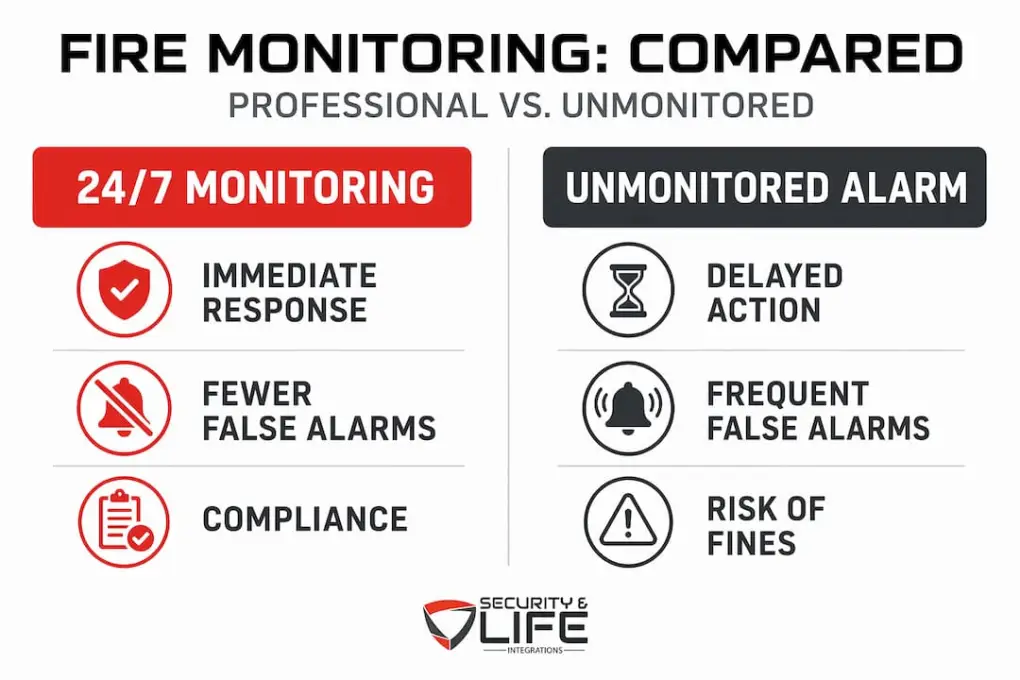
The comparison below makes the operational difference concrete.
| Feature | Professional 24/7 monitoring | Unmonitored local alarm |
|---|---|---|
| Emergency dispatch speed | Within seconds of alarm trigger | Depends on occupant calling 911 |
| Off-hours protection | Full coverage at all times | No coverage if property is unoccupied |
| Alarm verification | Trained operators confirm before dispatch | No verification process |
| False alarm management | Operators filter non-emergency triggers | Every alarm triggers a direct response or is ignored |
| Compliance status | Meets NFPA 72 and most local codes | Does not meet commercial requirements |
| Insurance impact | Frequently qualifies for premium reduction | No insurance benefit |
| System health monitoring | Proactive fault and battery alerts | No reporting until system fails |
The contrast in false alarm management is worth noting separately. Verification protocols reduce costly false alarms and unnecessary fire department call-outs, which protects your credibility with local authorities. Properties with repeated false alarms from unmonitored systems can face fines and, in some jurisdictions, delayed responses when real emergencies occur.
My perspective on why monitoring is an operational necessity
I’ve worked with property managers long enough to see the same pattern repeat. A manager installs compliant fire alarms during a renovation, passes inspection, and assumes the job is done. Years go by. A sensor battery dies. A fault develops in the control panel. Nobody knows because there is no monitoring system watching for those events. Then something goes wrong.
What I’ve learned is that the value of 24/7 monitoring is not just the emergency dispatch speed. It’s the continuous system oversight that keeps your protection from going quietly offline. Most property managers are not thinking about their fire system at 2 a.m. on a Sunday. A monitoring center is.
I’ve also found that property managers who treat monitoring as a pure compliance checkbox tend to underinvest in provider quality. They pick the cheapest option, skip the dual-path communication upgrade, and end up with a system that looks compliant on paper but has real gaps in reliability. The right provider costs a bit more and saves significantly more.
My take is direct: if you manage a commercial property or any multi-unit residential building, 24/7 fire monitoring is not optional. It is a basic operational responsibility. The fire safety monitoring benefits go well beyond the monthly monitoring fee, and the downside of not having it, whether measured in property loss, liability exposure, or lives affected, is too significant to accept.
— Zachary
How Security & Life Integrations can help

Security & Life Integrations provides professionally installed, UL-certified fire alarm systems with continuous 24/7 monitoring for commercial, multi-tenant residential, and HOA properties. Their NICET-certified technicians handle installation, system integration, and ongoing maintenance, so your fire protection stays current with code requirements without you managing it manually. Systems integrate with sprinkler controls, suppression equipment, and access control platforms for a coordinated response across your entire property. If you manage multiple buildings or a large multi-tenant portfolio, their multi-tenant fire protection solutions are built specifically for the compliance and reporting demands you face. Contact Security & Life Integrations for a consultation and system assessment.
FAQ
What does 24/7 fire monitoring actually do?
A 24/7 fire monitoring system transmits alarm signals from your detectors to a staffed monitoring center, which contacts emergency services within seconds. Trained operators verify the alarm and dispatch responders regardless of whether anyone is present at the property.
Is professional fire monitoring required by law?
For most commercial and multi-tenant residential properties, yes. NFPA 72 requires continuous fire alarm supervision that notifies emergency responders automatically, and many local building codes go further with property-type-specific mandates.
How does monitored fire detection reduce false alarms?
Monitoring center operators call your designated contacts to verify the cause of an alarm before dispatching emergency services. This filter prevents unnecessary fire department responses and protects your credibility with local authorities over time.
What is the cost of fire monitoring services for commercial properties?
Professional monitoring for commercial properties typically costs between $30 and $100 per month depending on system size and reporting level. Many property insurers offset part of that cost through premium reductions for monitored properties.
Can fire monitoring systems integrate with other building systems?
Yes. Modern fire monitoring systems connect with sprinkler controls, suppression systems, access control doors, and emergency lighting. When an alarm triggers, the integrated response activates multiple building systems simultaneously for faster and more effective protection.