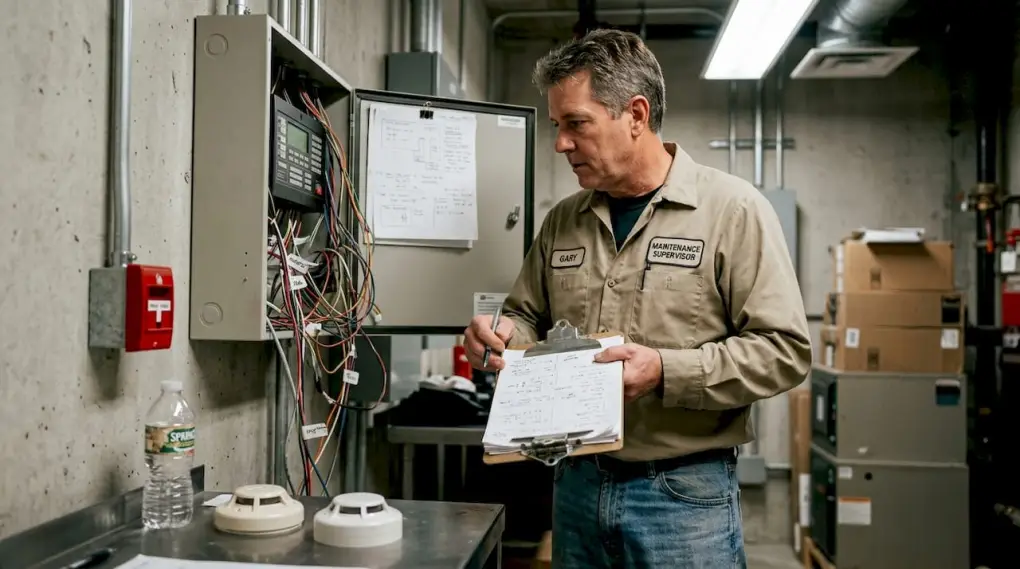
Working smoke alarms reduce fire death risk by 55%, yet many facilities operate with outdated detectors, improper placement, or systems that have never been fully tested. For property managers, business owners, and HOA leaders, that gap between having a fire alarm and having an effective one is where real risk lives. This guide breaks down how fire alarm systems work, what the key components do, and what you need to know to keep your facility safe and compliant.
Table of Contents
- Understanding the basics: What is a fire alarm system?
- How detectors sense fire: Smoke, heat, and multi-sensor technology
- How fire alarm systems notify and respond
- Common challenges: False alarms and maintenance
- Practical steps for managers: Optimizing fire alarm safety and compliance
- Ensure your facility’s fire safety is up to code
- Frequently asked questions
Key Takeaways
| Point | Details |
|---|---|
| Detector types matter | Choosing the right smoke and heat detection methods improves safety and reduces false alarms. |
| Maintenance is crucial | Inspect, clean, and replace detectors regularly to ensure system reliability and compliance. |
| Multi-sensor improves reliability | Combining smoke, heat, and CO sensors reduces nuisance alarms and enhances fire detection. |
| Alarms need proper placement | Correct positioning and regular checks are vital for accurate system performance. |
Understanding the basics: What is a fire alarm system?
A fire alarm system is a network of devices designed to detect fire conditions and alert occupants so they can evacuate safely. It also notifies emergency responders and, in many cases, triggers suppression systems. These systems are not optional in most commercial and multifamily properties. They are required by local fire codes and national standards.
Every fire alarm system includes several core components working together:
- Initiating devices: Smoke detectors, heat detectors, and manual pull stations that detect or report a fire condition
- Control panel: The central hub that receives signals from initiating devices and activates notification equipment
- Notification appliances: Horns, strobes, and speakers that alert occupants
- Power supply: Primary AC power with battery backup to keep the system running during outages
- Monitoring connection: A link to a central monitoring station or directly to emergency services
Understanding these components matters because each one has specific maintenance requirements and failure points. A system is only as reliable as its weakest component. For compliance purposes, every part must meet the standards set by the National Fire Protection Association (NFPA), specifically NFPA 72, which governs fire alarm and signaling systems in the United States.
How detectors sense fire: Smoke, heat, and multi-sensor technology
Not all detectors work the same way. The technology inside a detector determines what type of fire it catches quickly and where it performs best. Smoke detectors use ionization or photoelectric sensors, and each has distinct strengths.
Ionization detectors use a small amount of radioactive material to ionize air inside a sensing chamber. When smoke enters, it disrupts the ion flow and triggers the alarm. These units respond faster to fast-flaming fires with small combustion particles.
Photoelectric detectors use a light beam and a sensor. Smoke scatters the light onto the sensor, triggering the alarm. These respond faster to slow, smoldering fires that produce larger particles and more visible smoke.
Here is a direct comparison to help you choose the right detector for each area of your facility:
| Detector type | Best for | Weakness |
|---|---|---|
| Ionization | Fast-flaming fires | Slower on smoldering fires |
| Photoelectric | Smoldering fires | Slower on fast-flaming fires |
| Heat: fixed-temperature | Kitchens, garages | Does not detect smoke |
| Heat: rate-of-rise | Areas with temp swings | Can false alarm in hot climates |
| Multi-sensor | General facility use | Higher upfront cost |
Heat detectors come in two types. Fixed-temperature units trigger when the air reaches a set temperature, typically 135°F or 194°F. Rate-of-rise units trigger when temperature increases faster than 12°F to 15°F per minute. Heat detectors work well in kitchens, boiler rooms, and areas with dust or high airflow where smoke detectors would generate constant false alarms.
Key fact: NIST recommends dual-sensor smoke detectors that combine both ionization and photoelectric technologies. These units provide broader coverage across different fire types and reduce the chance of a missed detection.
Multi-sensor devices go further by combining smoke detection, heat sensing, and carbon monoxide (CO) detection in one unit. For facilities with mixed-use spaces or areas where fire behavior is unpredictable, these devices reduce gaps in coverage without requiring multiple separate detectors.
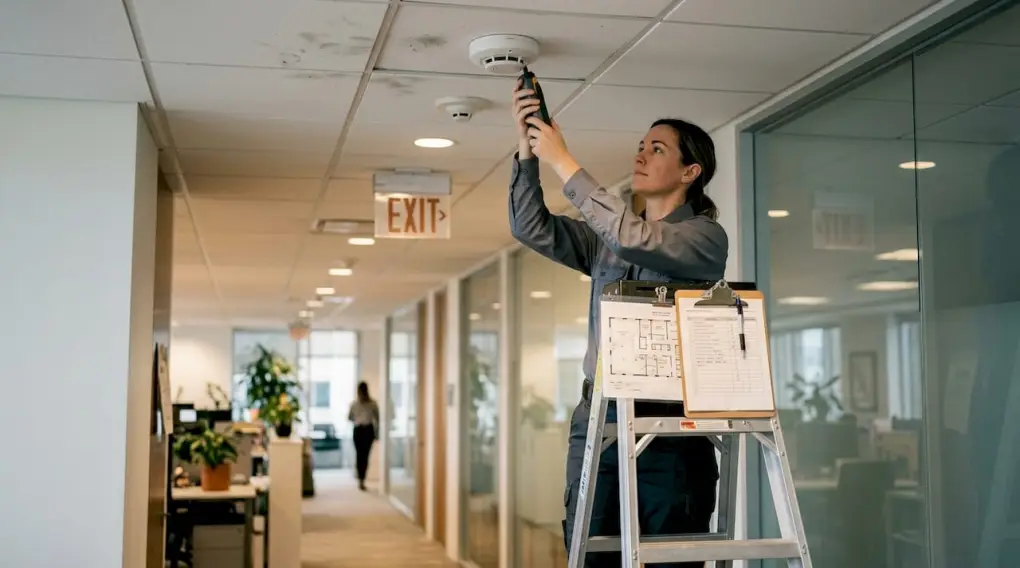
Pro Tip: In commercial kitchens or laundry rooms, use heat detectors instead of smoke detectors. Cooking fumes and steam will trigger smoke detectors repeatedly, leading staff to disable them, which creates a serious safety gap.
How fire alarm systems notify and respond
Detection is only the first step. Once a detector senses a fire condition, the signal travels through a defined pathway before occupants hear an alarm. Understanding this pathway helps you identify where delays or failures can occur.
Here is how the signal moves from detection to response:
- A detector or pull station sends a signal to the fire alarm control panel (FACP)
- The FACP processes the signal and confirms it is a valid alarm condition
- The panel activates notification appliances throughout the building
- If monitored, the panel transmits a signal to a central monitoring station
- The monitoring station contacts the local fire department
- Emergency responders are dispatched to the facility
Notification appliances vary based on occupancy type and code requirements. Audible devices like horns and bells alert occupants who can hear them. Visual devices like strobes serve occupants with hearing impairments and are required in most commercial and public spaces under the Americans with Disabilities Act (ADA). Voice evacuation systems broadcast recorded or live messages, which are especially useful in large facilities where occupants need specific instructions.
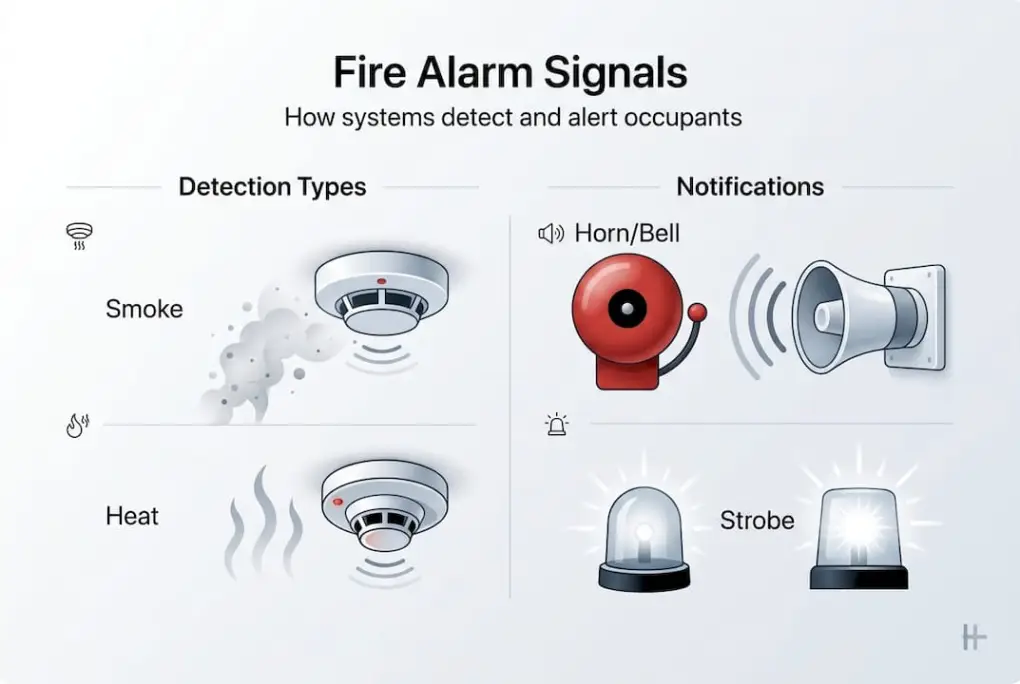
| Notification type | Application | Code requirement |
|---|---|---|
| Horn/bell | General occupancy | NFPA 72 |
| Strobe | ADA-required spaces | ADA, NFPA 72 |
| Voice evacuation | Large or complex buildings | IBC, NFPA 72 |
| Combination horn/strobe | Mixed occupancy | NFPA 72 |
Trouble signals occur when the system detects a fault rather than a fire. Common causes include low battery voltage, ground faults in wiring, and communication failures between the panel and monitoring station. Trouble signals require immediate attention because they indicate the system may not function correctly during an actual fire.
Common challenges: False alarms and maintenance
False alarms are one of the most persistent problems in facility fire safety. They disrupt operations, desensitize occupants to alarm sounds, and in some jurisdictions, result in fines from the fire department. False alarms from dust, cooking, and insects are common in commercial and multifamily settings.
The most frequent sources of false alarms include:
- Dust or debris accumulation inside detector sensing chambers
- Steam or cooking fumes reaching smoke detectors near kitchens
- Insects entering detector housings and triggering sensors
- Detectors placed too close to HVAC vents or in high-airflow areas
- Aging detectors with degraded sensors that respond to non-fire conditions
Maintenance is the most direct way to reduce false alarms and keep your system reliable. Batteries in standalone detectors typically need replacement every one to three years. The control panel battery backup requires testing and replacement on a schedule set by the manufacturer and NFPA 72.
Pro Tip: Schedule detector cleaning as part of your annual inspection. A can of compressed air directed into the sensing chamber removes dust and insect debris that accumulates over time. This simple step reduces false alarms significantly in dusty or high-traffic areas.
“Working smoke alarms reduce fire death risk by 55%. A system that generates constant false alarms is one that occupants learn to ignore, which eliminates that protective benefit entirely.”
Detector sensitivity also drifts over time. Older units may become either too sensitive, triggering on minor particles, or not sensitive enough, missing early fire conditions. This is why replacement schedules matter as much as cleaning.
Practical steps for managers: Optimizing fire alarm safety and compliance
Knowing how the system works is useful. Knowing what to do with that knowledge is what protects your facility and keeps you compliant. Here are the steps that matter most for property managers, business owners, and HOA leaders.
- Follow the replacement schedule. Detectors should be replaced every 8-10 years and batteries every 3-5 years per NFPA data. Document replacement dates on each unit or in your maintenance log.
- Conduct annual inspections. NFPA 72 requires annual testing and inspection by a qualified technician. Keep records of every inspection, test result, and repair. These records are reviewed during fire marshal inspections.
- Verify detector placement. Detectors must be placed according to NFPA 72 spacing requirements. Ceiling-mounted smoke detectors should be no more than 30 feet apart in open areas. Placement near HVAC vents, in corners, or directly above cooking equipment creates problems.
- Review your monitoring contract. Confirm that your central monitoring station is UL-listed and that the communication path between your panel and the station is tested regularly. A monitoring gap means emergency responders may not be notified automatically.
- Upgrade to dual-sensor or multi-sensor detectors. If your facility still uses single-technology detectors, upgrading to dual-sensor units improves detection reliability across fire types without a full system replacement in most cases.
- Train your staff. Occupants and staff should know the difference between an alarm signal and a trouble signal, how to use manual pull stations, and what the evacuation plan requires. Training reduces panic and improves response time.
Compliance is not a one-time event. Codes update, occupancy types change, and systems age. Building a routine around these steps keeps your facility ahead of both safety risks and regulatory requirements.
Ensure your facility’s fire safety is up to code
Reviewing your fire alarm system against current NFPA 72 requirements, verifying detector placement, and confirming your monitoring connection are all tasks that require technical knowledge and documentation. Many facility managers find that working with a qualified provider simplifies this process and reduces liability.

Security & Life Integrations provides fire safety consulting and UL-certified fire protection system services for commercial properties, multifamily housing, and HOA communities. Whether you need a full system installation, a compliance audit, or support taking over an existing system, the team at Security & Life Integrations brings the technical expertise and documentation support your facility needs. You can reach them directly through their website to schedule an assessment and confirm your system meets current code requirements.
Frequently asked questions
How often should fire alarm detectors be replaced?
Fire alarm detectors should be replaced every 8-10 years to maintain reliable performance. Aging sensors drift in sensitivity and may fail to detect fire conditions accurately.
What causes false fire alarms in commercial facilities?
False alarms result from dust, cooking fumes, insects, or detectors placed in high-airflow or high-humidity areas. Multi-sensor detectors and correct placement reduce these incidents significantly.
Are dual-sensor smoke detectors better for facility safety?
Yes. Dual-sensor detectors combine ionization and photoelectric technologies, which improves detection across both fast-flaming and slow-smoldering fire types. NIST recommends them for broader facility coverage.
How are fire alarms connected to emergency responders?
Fire alarm control panels transmit signals to a central monitoring station, which then contacts the local fire department. Some systems connect directly to emergency dispatch, depending on local code requirements and the monitoring setup in place.